Breaking the PC laptop mould

When you think of a brand-new laptop, does ASUS make your short list? If it does not, ASUS is a brand that, over the last few years, has been breaking the PC laptop mould and bringing innovation to the market. Innovation that is not gimmicks but actual features that make sense.

I declare that I am a guest of ASUS at their recent enterprise summit in Singapore. What surprised me was that ASUS’s 2025 sales revenue for consumer PCs exceeded those of the big brands, HP and Dell. Overall, ASUS is number 2 in the worldwide laptop market.

A very bold move at this event: they had on display not only their own products but also their competitors’. Their new business PC, the ASUS ExpertBook Ultra, has many small features that make it worth considering over other options. See our review of this new laptop here. To demonstrate why they believe this product is so good, they asked attendees at their event to compare its performance, durability, and usability with competitors’ products. This is a very bold move, and most companies tread very carefully when comparing themselves so openly with the competition.

ASUS is calling its new Laptop the flagship of the entire laptop industry and believes its tech empowers people more than others.

I have been using the PC for a month and will return it this week. My key takeaways are 1. The durability of the product is impressive 2. ASUS has made a product with features attractive not only to users but also to the IT departments that must manage them. This machine is super responsive. 3. When using it everything happens fast.  Going back to my old PC feels like going back to an old smartphone after having experienced the latest.

It has the best of everything, which isn’t for everyone, as this superior technology comes at a price to match. This aside, it further proves that ASUS, as a brand with its greater range, should be considered, especially if you want the current best.

Some of the features that I liked about the ASUS ExpertBook Ultra that is not in the brochure include:

  • Can be charged, be it very slowly, from a USB-C cable with as little as 15W (5V@3A)
  • The warranty covers all parts, including the battery. Other vendors have a shorter warranty on batteries
  • Smallest footprint laptop for a 14-inch display
  • They have a self-maintenance program, which is great for businesses with a fleet of laptops, where ASUS will train your IT person, then send them warranty parts so you can fix your own Laptops and get the user back online faster

During the conference, it was also interesting to hear from Microsoft and their thoughts on the Ultra. They, of course, looked at the laptop running Copilot PC and quoted 19 hours of battery life whilst web browsing (ASUS quoted up to 27 hours of video playback). Microsoft measured 3.5x faster performance and 2x Office productivity.

Google also spoke, and a scary key statistic they shared was that 98% of organisations have unsanctioned AI apps running in their environments. This further alarms when they quote that 43% admit their sensitive information is being shared with public AI. Google has launched tools to discover these breaches, enforce protection and introduce Governance.

My takeaway for small businesses is that ASUS is making PCs for a better user experience rather than just adding the latest tech, unlike most other vendors. That said, if you can afford this new laptop, you will not be disappointed; it has class-leading tech. Remember, you can have all the tech in the world, but your employees remain the biggest risk to your organisation’s data security. AI PCs are the future, but also the risk.

Review: Is the ASUS ExpertBook Ultra the Ultimate Business Laptop?

In the corporate world, hardware choice is often restricted to a pre-approved list curated by IT departments. However, whether you are a decision-maker looking to outfit a fleet or an employee hoping to advocate for a better workstation, it is crucial to understand what separates a premium business machine from a standard home laptop. This review explores why the ASUS ExpertBook Ultra deserves a top spot on that list.

Business vs. Home: Why the Distinction Matters

Historically, home PCs have prioritized multimedia power and price-to-performance ratios, while business models focused on stability, security, and ease of management. Today, those lines are blurring. As AI becomes an integral part of professional workflows, business machines now require the same high-end graphical processing power that was once reserved for gaming or creative rigs.

Design and Portability: Lightweight Yet Rugged

The ExpertBook Ultra is a 14-inch, AI-focused powerhouse designed for the modern professional. Weighing in at less than 1kg, it is exceptionally portable—perfect for frequent travelers. Despite its feathery weight, it is built to survive the rigors of business travel. Constructed with an aviation-grade magnesium alloy frame and a scratch-resistant chassis, it is engineered to withstand impacts that would dent lesser machines.

Under the Hood: Performance and AI

This laptop is built for demanding tasks, thanks to the Intel Core Ultra X9 388H processor paired with a 50W integrated Intel Arc B390 GPU. This combination creates one of the most capable portable AI engines on the market. ASUS has also optimized the thermal management, ensuring the system remains cool and quiet, even during heavy tasks like moderate CAD work.

To keep data moving fast, the device utilizes a 2TB PCIe Gen 5×4 SSD, which offers read/write speeds that effectively double those of previous-generation drives. When you pair this with 64GB of high-speed memory, the system handles memory-intensive AI tasks without breaking a sweat.

Battery and Charging

The 70Wh battery is rated for exceptional longevity, potentially lasting through several days of light usage. The rapid-charge capability is a standout: a mere 15-minute charge can net you up to six hours of battery life. Because it charges via USB-C, you can streamline your travel bag by using the same charger for your smartphone and your laptop.

Display and Audio Experience

ASUS brings its expertise in OLED technology to the ExpertBook Ultra. The 14-inch, 3K tandem OLED display is exceptionally bright, making it easy to read even in outdoor environments. It features a matte finish that resists fingerprints and is protected by Gorilla Glass Victus.

For audio, the six-speaker system supports Dolby Atmos, offering sound quality rarely seen in 14-inch devices. Additionally, the AI-powered noise-canceling microphone ensures that your voice remains clear during video calls, regardless of background noise.

Usability and Connectivity

Typing is a pleasure thanks to the keyboard’s 1.5mm travel and durable, wear-resistant coating. The 11cm haptic touchpad mimics the feel of a physical mouse, providing satisfying tactile feedback. For connectivity, the laptop is future-proofed with Wi-Fi 7, dual 40Gbps Thunderbolt 4 ports, USB-A, and a full-sized HDMI port.

ASUS ExpertBook Ultra Specifications

FeatureSpecification
Processor/GraphicsIntel Core X9-388H, Intel Arc B390
Memory/Storage64GB LPDDR5x, 2TB M.2 PCIe Gen 5
Wi-FiWi-Fi 7 (IEEE 802.11be)
Battery LifeUp to 26 hours
Dimensions31 x 21 x 1 cm
Warranty5-year coverage

Real-World Usage: The User Perspective

After spending a month with the device, the only notable drawback is the sensitivity of the touchpad, which can occasionally be triggered accidentally while typing. Beyond that, the laptop is a delight. Small thoughtful touches—like the ability to dim the screen to extremely low levels for privacy on a plane, a physical webcam privacy shutter, and directional Wi-Fi technology—show that ASUS understands the needs of mobile professionals.

The IT Decision: Why It Makes Sense

For IT departments, the ExpertBook Ultra is a dream for several reasons:

  • Military-Grade Durability: Tested to withstand high pressure, spill-resistant, and built to endure 100,000 scratches.
  • Longevity: A 5-year warranty and update cycle usually outlast standard refresh programs.
  • Security: Features include automatic walk-away locking, encrypted storage, and a “self-healing” BIOS that restores itself if an update fails.
  • Diagnostics: A built-in sensor light helps IT staff quickly diagnose hardware issues.

The Verdict

The ASUS ExpertBook Ultra is a premier business tool that doesn’t sacrifice performance for portability. It pushes the boundaries of what a 14-inch laptop can do, making it an excellent choice for any professional who values power, security, and design.

Would you like me to adjust the tone of this rewrite to be more formal for a corporate blog, or is this balanced style what you were looking for?

GaN charger with up to 240W and five ports

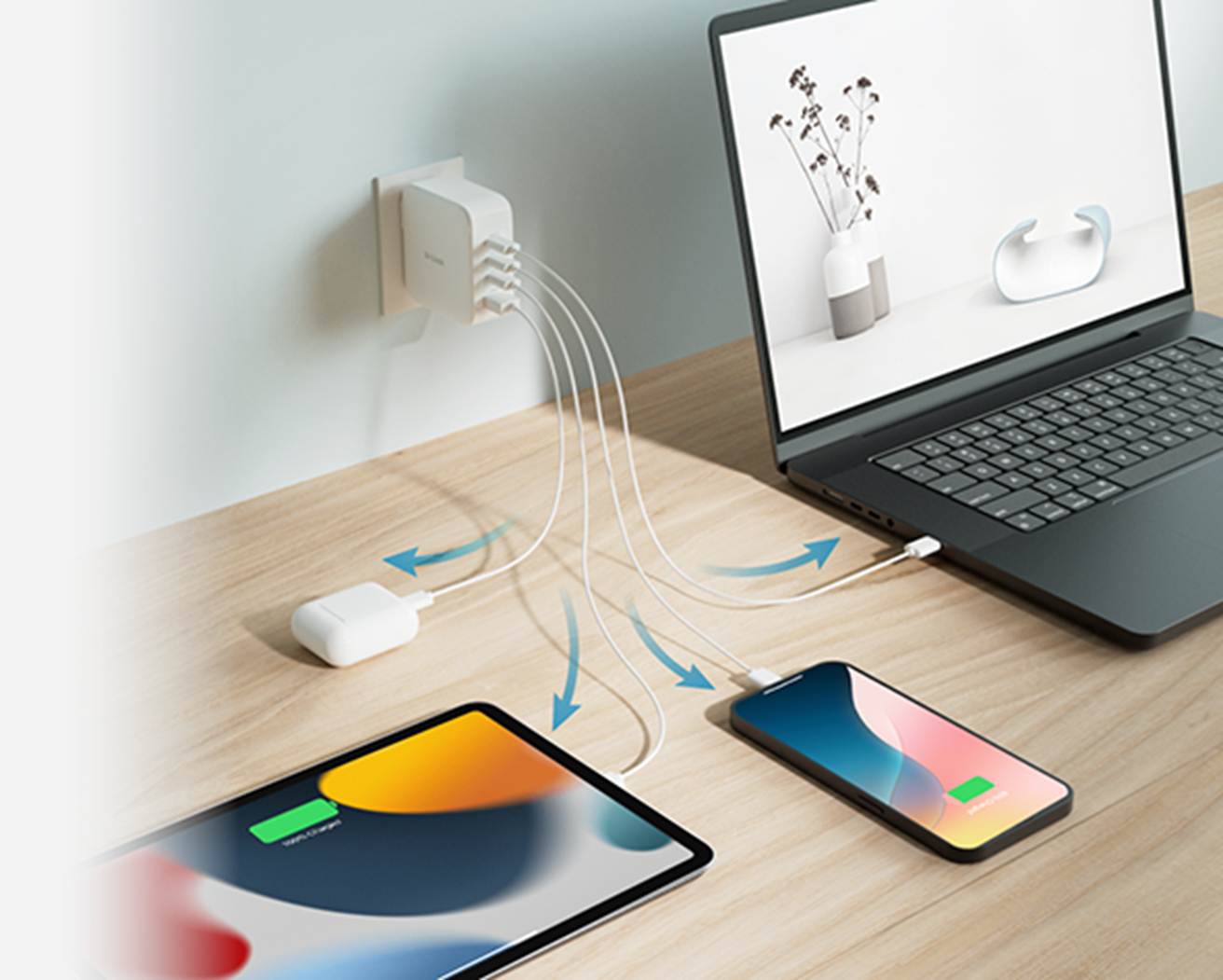
D-Link has expanded its Tech Essentials range with three high-performance GaN chargers designed to power everything from flagship laptops to phones, tablets, handheld gaming and accessories, all from fewer, smaller adapters. The new line-up includes the DCF-241 240W GaN Charger, the DCF-141 140W GaN Charger and the DCP-101 100W GaN Charger. Each model uses next-generation Gallium Nitride (GaN) power technology for faster, cooler and more efficient charging in a compact design, with USB-C Power Delivery 3.1 (PD 3.1) and Quick Charge 4.0 (QC 4.0) support, and intelligent power distribution across multiple ports so consumers can replace a tangle of bricks with a single, travel-friendly solution.

D-Link A/NZ MD Graeme Reardon said, “Most homes still have a drawer of mismatched chargers and a tangle of bricks on the desk. The new D-Link GaN range fixes that with three sizes covering everything from a phone to a 16-inch laptop, in adapters small enough to throw in a backpack.”

D-Link’s DCF-241 is a multi-device charging hub built for modern households and shared workspaces. With up to 240W total output across five charging ports (four USB-C and one USB-A), and PD 3.1 plus QC 4.0 support, it can rapidly charge multiple laptops alongside phones, tablets, earbuds and wearables at the same time. A single USB-C port can deliver the full 140W on its own, enough to fast-charge a 16-inch MacBook Pro or a high-end Windows workstation while the remaining ports keep the rest of the household powered.

That means you can top up a USB‑C MacBook Pro or Windows ultrabook at high wattage while still fast‑charging a phone and tablet, all from one compact desktop unit.

The DCF-241 is ideal for kitchen benches, study nooks and meeting rooms where everyone needs power without fighting over sockets. It’s also a smart pick for creators who need to keep a laptop, camera batteries, tablet and phone ready to go. A compact stand holder keeps the charger upright on the desk for clean cable management, and advanced safety features help protect devices under heavy load.

DCF-141: a versatile 140W fast charger for dual-laptop days and travel

The DCF-141 delivers up to 140W of total power in a four-port design (three USB-C and one USB-A), small enough to suit commuters, students and frequent travellers who want one adapter that can handle work and personal gear. Two of its USB-C ports can deliver 70W each simultaneously, fast-charging two laptops at the same time, ideal for couples sharing a desk or travellers carrying a work and personal machine.

High-output USB-C power delivery lets you charge a professional laptop at speed, while the four-port design means you can keep a phone or tablet topped up at the same time without sacrificing performance.

It’s the simple way to slim down your tech kit: one charger in the bag, less clutter on the desk, and fast top‑ups between meetings and classes.

DCP-101: compact 100W everyday charger that punches above its size

For daily carry, the DCP-101 offers up to 100W of total output across four ports (three USB-C and one USB-A). A single USB-C connection can power a laptop at up to 100W, or share intelligently across multiple devices when you plug more in.

It is a great match for ultrabooks, Chromebooks, the iPad Pro, Nintendo Switch and fast-charging Android and iPhone models.

Despite the power, it’s compact thanks to GaN technology, so it fits neatly in a backpack pocket or bedside drawer ready for home, office or travel.

In short, D-Link’s new GaN chargers are a smarter choice than traditional silicon chargers which are bulky and can run hot.

D-Link’s GaN architecture is more efficient, enabling smaller designs that stay cooler and waste less energy. Each new model supports the latest USB-C Power Delivery 3.1 and Quick Charge 4.0 fast-charging standards, with intelligent power allocation that detects what you’ve plugged in and delivers the right wattage to each device. With 110 to 240V AC input across the range, all three chargers travel anywhere in the world with just a plug adapter.

Built-in safety protections include over-current, over-voltage, over-temperature and short-circuit safeguards, all of which provide peace of mind for families and professionals alike.

These new D-Link GaN chargers are designed for how Australian and New Zealand households charge now. Whether you’re a household with multiple laptops, a student juggling a notebook and phone or a traveller who wants one compact charger for everything, D-Link’s new Tech Essentials GaN chargers replace multiple wall bricks with a single, reliable solution. The result is less clutter, fewer power boards and faster top-ups across all your devices.

The DCF-241 (240W), DCF-141 (140W) and DCP-101 (100W) GaN Chargers are available now in Australia at www.dlink.com.au, and through authorised retail partners, for the following RRP:

DCF-241: Up to 240W total output across four USB-C and one USB-A ports, with a 140W single-port maximum; ships with a compact stand holder. RRP: AU$249.95. On EOFY tax-time promotion at AU$229.95 in Australia through 30 June.

DCF-141: Up to 140W total output across three USB-C and one USB-A ports, with 70W + 70W dual-laptop fast-charging. RRP: AU$129.95.

DCP-101: Up to 100W total output across three USB-C and one USB-A ports; compact everyday charger for laptops, phones, tablets and accessories. RRP: AU$99.95.

Models at a glance:

ModelTotal OutputSingle-Port MaxPortsRRP AURRP NZ
DCF-241240W140W4 x USB-C + 1 x USB-A$249.95$349.99
DCF-141140W140W (or 70W + 70W dual)3 x USB-C + 1 x USB-A$129.95$179.99
DCP-101100W100W3 x USB-C + 1 x USB-A$99.95$139.99

Anthropic launches Claude for Small Business

 Claude for Small Business—a package of connectors and ready-to-run workflows that put Claude inside the tools small businesses depend on—to help small business owners take full advantage of AI and cross off items on the to-do list.

Small businesses account for 44% of U.S. GDP and employ nearly half the private-sector workforce, but their adoption of AI has lagged behind that of larger enterprises. Tools and training are rarely tailored to the ways small businesses operate, and as a result, their use often stops at the chat window. As part of our public benefit mission, we are committed to helping business owners harness AI more fully and effectively for their most important work.

Claude for Small Business is a toggle install that puts Claude to work inside the tools small business owners already use: Intuit QuickBooks, PayPal, HubSpot, Canva, DocuSign, Google Workspace, and Microsoft 365. From these tools, it can plan payroll, close the month, run a sales campaign, chase invoices, and more.

“Small businesses make up nearly half the American economy, but they’ve never had the resources of bigger companies. AI is the first technology that can finally close that gap, which is why we’re launching Claude for Small Business, alongside training and partnerships to make sure AI shows up for the entrepreneurs and communities who need it most. Claude for Small Business runs within the tools owners already rely on, like QuickBooks, PayPal, and HubSpot, and takes on the work that piles up after hours, such as planning payroll, chasing invoices, or kicking off a marketing project. People run the business, and Claude helps take the late-night work off their plates.”

—Daniela Amodei, Co-founder and President of Anthropic

How it works

Toggle on Claude for Small Business inside Claude Cowork, connect the tools you already use, and pick the job. Claude does the work; you approve before anything sends, posts, or pays.

It ships with 15 ready-to-run agentic workflows across finance, operations, sales, marketing, HR, and customer service. It also includes 15 skills built on the repeatable tasks owners told us slow them down most.

These include:

  • Planning payroll with confidence. Settle your QuickBooks cash position against incoming PayPal settlements, build a 30-day forecast, rank what’s overdue, and queue the reminders for you to approve and send.
  • Closing the month with fewer errors. Reconcile your books against settlements, flag what doesn’t match, write a plain-English P&L, and export a close packet you can forward straight to your accountant through Intuit QuickBooks.
  • Getting a pulse on your business. Surface your most important business insights on a schedule, all on one page: view your cash position through Intuit QuickBooks, sales trend, pipeline movement, this week’s commitments, and more.
  • Running your next campaign. Find the slow stretch in your revenue, analyse your HubSpot campaign performance, draft the promo strategy, and generate the assets in Canva to prepare your next send.

There’s also an invoice chaser, margin analyser, month-end prepper, tax-season organiser, contract reviewer, lead triager, content strategist, and more.

Connect to your stack

Running through Claude Cowork, each connected tool handles a specific job:

  • PayPal powers settlements, invoicing, dispute resolution, and refunds within Claude.
  • Intuit QuickBooks handles payroll planning, the monthly close, and cash flow, along with tools to help businesses prepare for tax season, and reconciliation work that touches every other system.
  • HubSpot runs lead triage, customer pulse, and campaign attribution.
  • Canva generates content for every channel, enabling collaboration and editing with your team, publishing assets, and tracking performance.
  • DocuSign sends contracts for signature, tracks their status, and files the executed copies back where they belong.

The full list of skills, automations, and connectors is available on the solutions page.

Built for trust

In a survey we ran with small business owners, half named data security as their single biggest hesitation about AI.

With Claude for Small Business:

  • You stay in the loop. Every task and workflow you run within Claude is initiated by you. You approve the plan first or, when you’re ready, let it run end-to-end.
  • Your existing permissions hold. If an employee can’t see something in QuickBooks or Drive today, they can’t see it through Claude.
  • We don’t train on your data by default on our Team and Enterprise Plans.

Full details are in the Trust Centre.

AI Fluency for Small Business

Tools aren’t enough on their own. Owners and their teams need to know when and how to use them, and most haven’t had the opportunity to learn.

That’s why we partnered with PayPal on AI Fluency for Small Business, a free online course on using AI to run a small business. It’s taught by owners who’ve built it into their own operations—Prospect Butcher Co. in Brooklyn, MAKS TIPM Rebuilders in California, and others—with step-by-step guidance on using AI in your business safely, responsibly, and ethically. We’ll cover topics like identifying which tasks in your business are right for AI and how to get started.

“PayPal is proud to partner with Anthropic to help small and medium-sized businesses harness the full potential of the AI-led economy. Together, we are equipping these business owners and entrepreneurs with the tools, expertise, and trusted infrastructure they need to compete and thrive in a rapidly evolving digital economy and creating new opportunities for them to innovate, grow and better serve their customers.” — Amy Bonitatibus, Chief Corporate Affairs Officer at PayPal

The course is available on-demand today.

Partnering with small business–focused nonprofits

As a public benefit corporation, Anthropic’s mission includes ensuring that the gains from AI reach all people and communities, especially those who have historically been last in line for new technology. Small business owners—and the local institutions that fund and advise them—are exactly that audience. So alongside Claude for Small Business, we’re investing in partnerships that put Claude directly in the hands of small business owners and the organisations that help them grow.

We believe AI can meaningfully expand what’s possible for the smallest businesses, including solo entrepreneurs. Together with Workday and the Local Initiatives Support Corporation (LISC), we’re supporting the Workday Foundation Solopreneurship Accelerator Program, which in 2026 will equip an initial cohort of 15 aspiring solopreneurs with seed funding from the Workday Foundation, Claude credits from Anthropic, and an AI-first entrepreneurship curriculum developed by LISC.

Small businesses also depend on an enabling environment, including access to capital. That’s why we’re partnering with three Community Development Financial Institutions (CDFIs) that are deploying AI in their own operations and services: Accion Opportunity FundCommunity Reinvestment Fund USA, and Pacific Community Ventures. With Claude credits and hands-on technical support from our team, these CDFIs are building tools that help more small businesses get funded. Pacific Community Ventures, for example, is using Claude to power its Radiant Data Hub—a shared resource for a network of CDFIs—to collect and synthesise voice-based feedback from its small business clients and their workers to improve products and services.

Getting started

To learn more about Claude for Small Business and access the AI Fluency for Small Business course, get started here.

Highest labour productivity in nearly four years

Australian small business labour productivity has climbed to its highest level since 2022, according to Xero Small Business Insights (XSBI) productivity data released for the first time in Australia today. 

Productivity levels have spent two consecutive quarters above their long-term average, at a time when national productivity remains weak. In nominal terms, productivity rose  5.3% year-on-year (y/y) in the March quarter, following a 5.7% y/y increase in the December quarter. 

The XSBI productivity report analyses anonymised and aggregated data on sales, hours worked and number of employees from 154,000 Australian small businesses, producing a measure of small business labour productivity. It highlights the continuation of gradual productivity improvements collectively being made by Australian small businesses. 

At a glance – in the six months to March 2026: 

  • Australian small business labour productivity increased to $84.30/hour worked in the March quarter 2026, up from $83.80/hour worked in the December quarter 2025 – above the average for the six months prior ($82.40/hour worked) and the long-term average ($83.50/hour worked).
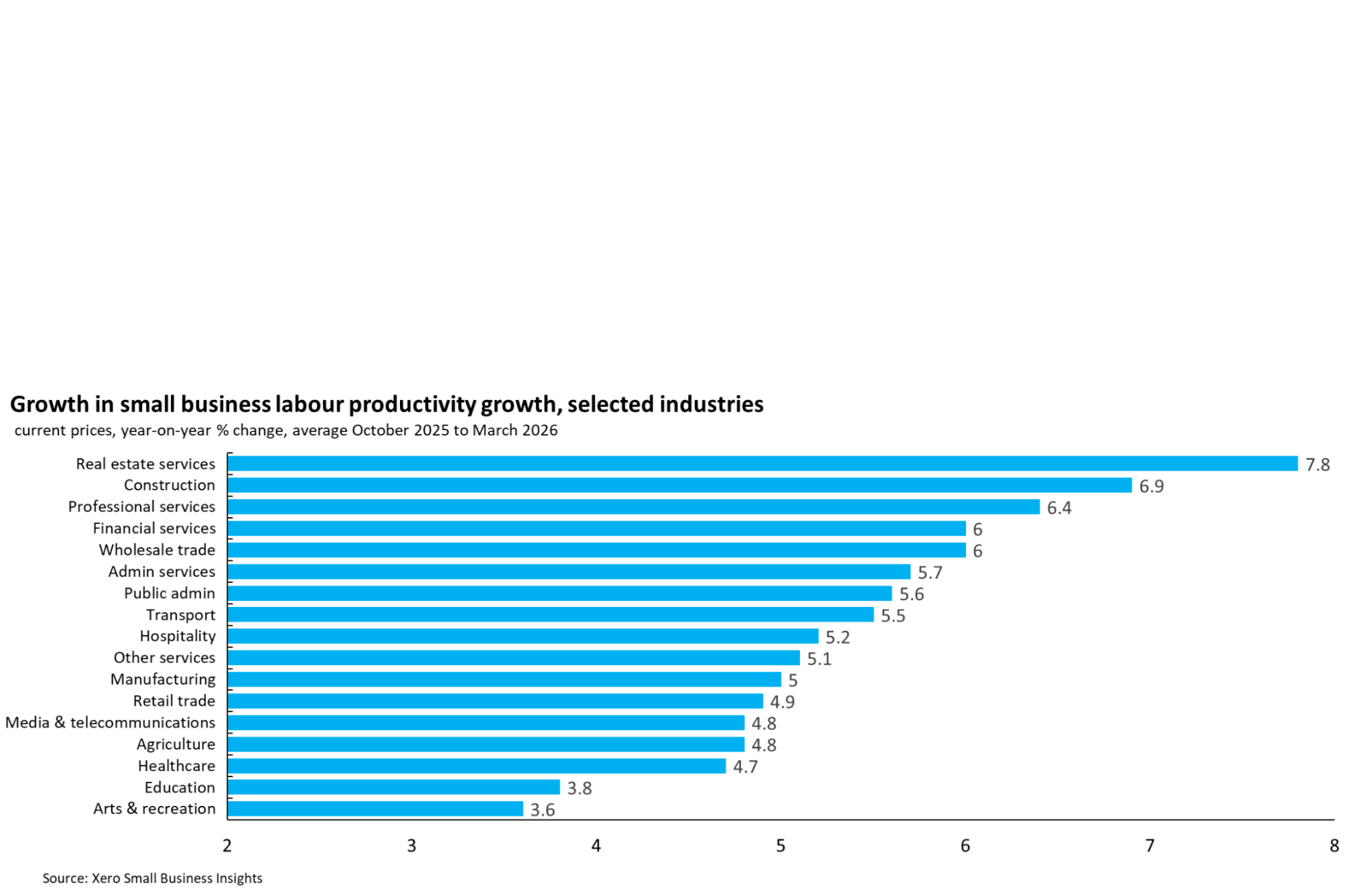
  • Real estate services (+7.8% y/y) and construction (+6.9% y/y) recorded the strongest nominal productivity growth in the past six months, while arts & recreation (+3.6% y/y) and education (+3.8% y/y) had the smallest growth over the same period. 
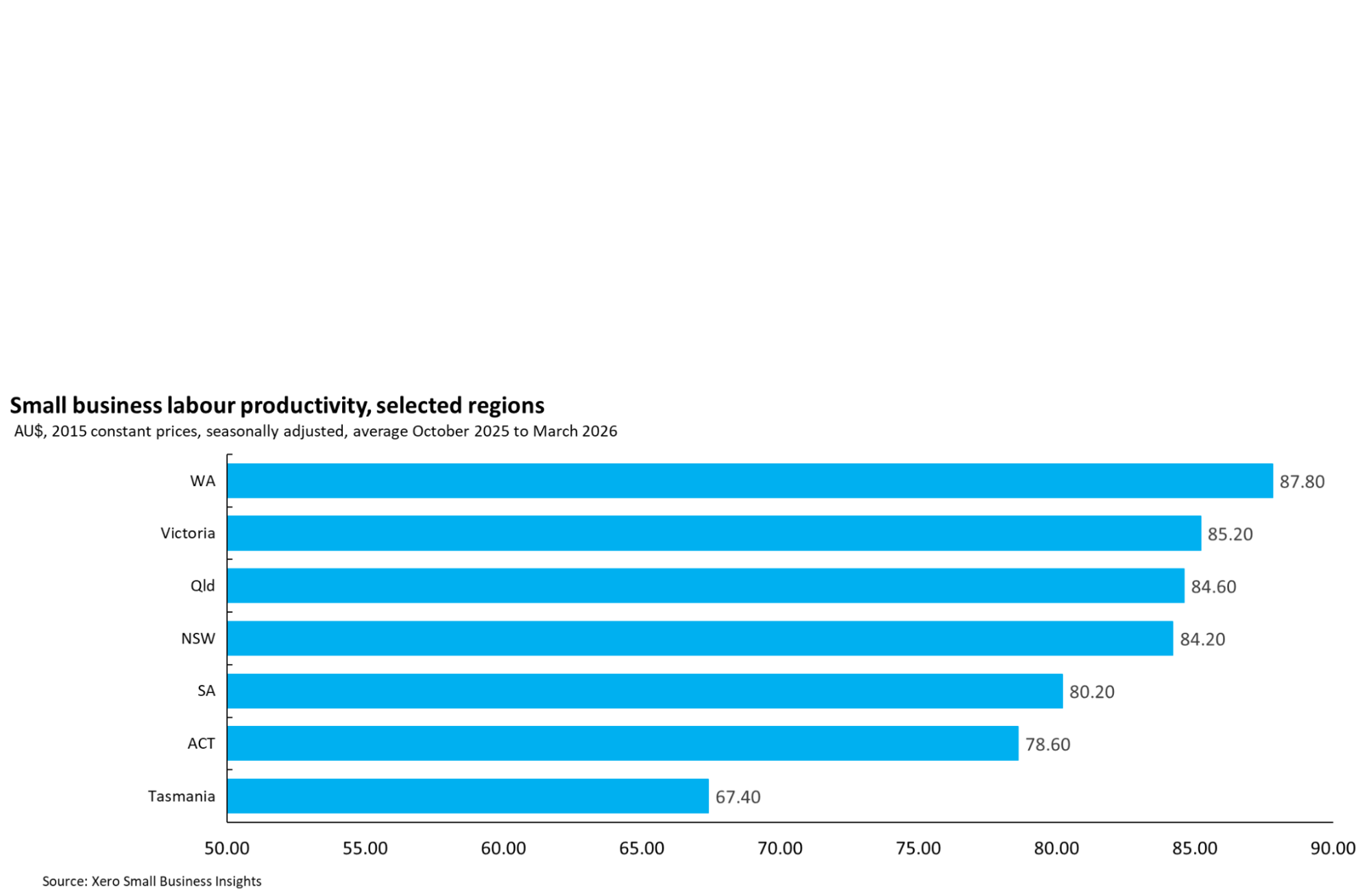
  • Western Australia led all states and territories with $87.80/hour, ahead of Victoria ($85.20/hour), Queensland ($84.60/hour) and NSW ($84.20/hour). Tasmania reported the lowest at $67.40/hour.

Louise Southall, Economist at Xero, said the findings show that not all businesses are experiencing the same productivity story. Small businesses, which account for more than 90% of Australian businesses, are building momentum yet are often underrepresented in national figures.

Southall said: “Our data provides a more representative picture of how Australian small businesses are actually performing. Small businesses have been building productivity momentum for two years, with gains over multiple quarters indicating sustained growth rather than a short-term cyclical spike. That matters for the broader economy because productivity growth allows businesses to expand and hire more staff, without adding to the inflation pressures Australians are already feeling.”

Construction and real estate lead growth, education falling behind 

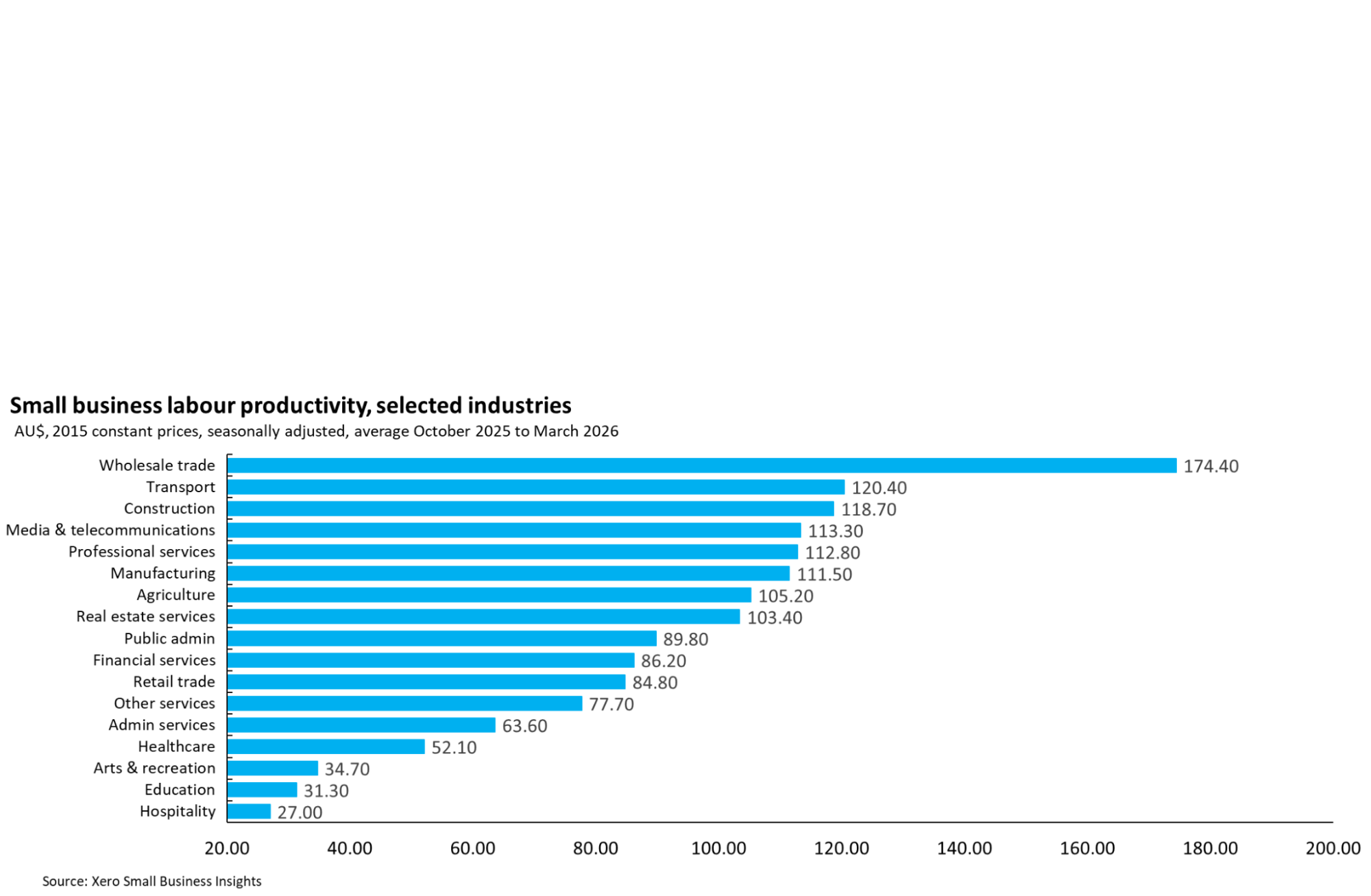
In terms of the level of productivity, wholesale trade ($174.40/hour), transport ($120.40/hour) and construction ($118.70/hour) were the strongest performing industries in the six months to March. This contrasts sharply with sectors like hospitality ($27.00/hour) and education ($31.30/hour), which were the least productive and generated the slowest growth momentum over the same period.

However, it was real estate services (+7.8% y/y) and construction (+6.9% y/y) that recorded the highest nominal growth rates over this period. 

Southall said state and industry differences were to be expected:

“Different industries and regions will naturally record different productivity outcomes – that’s what makes this data useful. It helps show policymakers and business leaders where productivity gains are emerging or where momentum may be slower. Construction’s growth, for example, shows what targeted reform can achieve, with government efforts to cut red tape appearing to be impactful. Education, however, is an area where the government can have considerable direct influence – and the data suggests there is real room to move.” 

Western Australia is Australia’s most productive state

Western Australia ($87.80/hour) recorded the highest small business labour productivity of all states and territories, most likely driven by the mining sector. Victoria ($85.20/hour), Queensland ($84.60/hour) and NSW ($84.20/hour) were closely grouped and all recorded strong growth over the period. South Australia ($80.20/hour), the ACT ($78.60/hour) and Tasmania ($67.40/hour) sit materially lower, with the data showing the four leading states achieved faster growth over the six months to March.

“Small businesses are the vast majority of Australian businesses but don’t always get the credit they deserve in the national economic conversation. This data shows that they have been improving productivity gains quietly and consistently – and unlocking more of that potential is one of the most powerful levers for sustainable economic growth. Digital tools, including those powered by AI, can support this by freeing up small business owners to focus on what actually drives business growth: generating sales, serving customers and growing their business,” said Southall.

Anne Aly MP, Minister for Small Business, said:

“These results speak strongly to the increasing contribution of small businesses to our economy. Small businesses have had to work hard through cost pressures, global uncertainty and some challenging economic shifts. This data shows their hard work is paying off.  Even with these external factors, 180,000 new small businesses have been started by Australians since July 2022. What is clear, is small businesses are building the kind of momentum the Australian economy needs.”

To find out more about how Xero Small Business Insights is constructed, see the methodology.

Printer productivity with EcoTank ET-2920 and ET-4900

Epson has highlighted the growing importance of cartridge‑free printing in the small office and home office (SOHO) segment, launching the EcoTank ET‑2920 and EcoTank ET‑4900 as compelling alternatives to entry‑level laser and traditional cartridge‑based printers.

Designed for modern hybrid work, both models deliver ultra‑low running costs, minimal maintenance and dependable everyday performance.

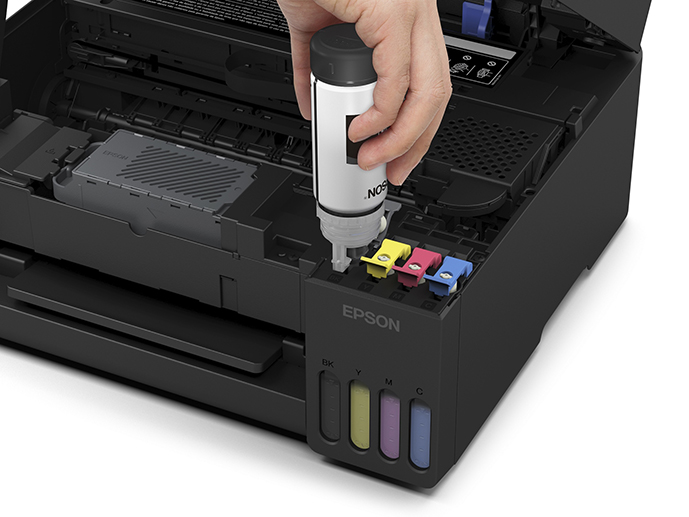
Epson EcoTank printers redefine printing economics by replacing cartridges with high‑capacity, refillable ink tanks. Each EcoTank printer comes with enough ink to print thousands of pages, significantly reducing the need to purchase replacement supplies and saving up to 90% on printing costs¹.

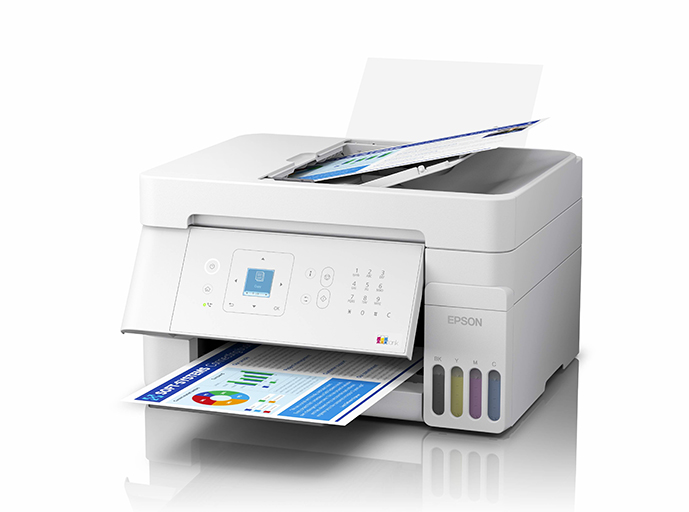
EcoTank ET‑4900

This approach offers clear advantages over both entry‑level laser and cartridge‑based ink models:

Ultra‑low cost per page

  • Includes enough ink to print thousands of pages right out of the box
  • Avoids expensive toner replacements and drum maintenance typical of laser printers
  • Far lower cost per page than standard cartridge devices

Fewer interruptions, greater productivity

  • Reduced need for consumable replacements minimises downtime
  • Ideal for SOHO users without dedicated IT support

Reduced waste and energy use

  • Cartridge‑free design significantly reduces plastic waste
  • Lower power consumption compared to many laser printers

Compact and quiet operation

  • No heat‑based printing means quieter performance
  • Smaller footprint suited to home offices and shared workspaces

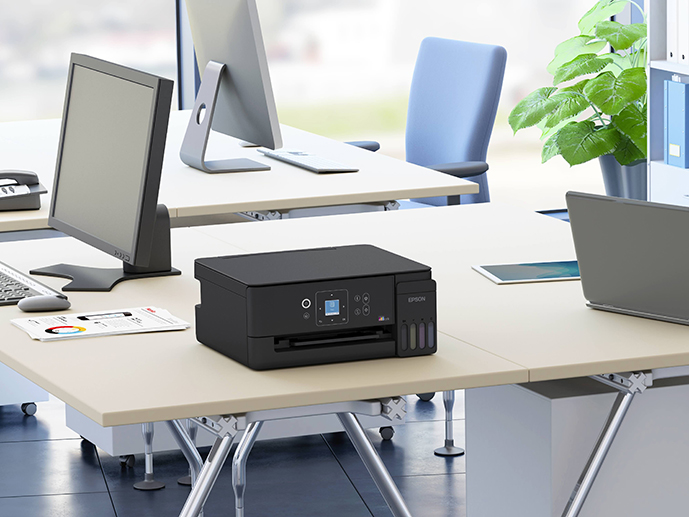
The ET‑2920 is designed for home office users and micro‑businesses looking for affordability and reliability.

Key features:

  • Print, scan, copy
  • Print speed – 11 pages per minute black² and white, 6 pages in colour²
  • Number of printed pages out of the box – 3,600³ black / 6,500³ colour
  • Cartridge‑free system with ultra‑low running costs
  • Wireless connectivity
  • Compact, easy‑to‑use design
  • Ideal for home offices, students and freelancers with moderate print needs

EcoTank ET‑2920

The ET‑4900 expands on EcoTank’s core strengths with productivity features suited for busier SOHO environments.

Key features:

  • Print, scan, copy plus fax
  • Automatic document feeder (ADF) for multi‑page workflows
  • Print speed – 11 pages per minute black² and white, 6 pages in colour²
  • Number of printed pages out of the box – 3,600³ black / 6,500³ colour
  • Wi‑Fi and Ethernet connectivity
  • Enhanced efficiency for document handling
  • Ideal for small businesses needing higher productivity, multi‑page scanning and office‑level functionality

As hybrid work continues to evolve, Epson EcoTank printers provide a future‑ready solution by offering:

  • Predictable and low operating costs
  • Minimal maintenance and downtime
  • Scalable performance to match business growth

Phil Daidone, Senior Product Manager, Epson Australia, said, “In the SOHO space customers are increasingly frustrated with the ongoing cost and maintenance associated with both entry‑level laser printers and traditional cartridge models. With EcoTank, we’ve fundamentally changed that experience delivering ultra‑low running costs, fewer interruptions and a simpler, more reliable way to print.

The ET‑2920 is perfect for users who want an easy, low‑cost solution for everyday printing, while the ET‑4900 adds the productivity features small businesses need to operate more efficiently as they grow. Together, they offer a smarter, more economical alternative for today’s hybrid work environment.”

The EcoTank ET‑2920 and ET‑4900 demonstrate Epson’s commitment to delivering practical, high‑value solutions for SOHO users. By eliminating cartridges and reducing total cost of ownership, these models outperform entry‑level laser and cartridge printers where it matters most – cost, convenience and reliability.

The Epson EcoTank ET-2920 (RRP $479) and ET-4900 (RRP $499) are now available at www.epson.com.au and through retail stores nationwide.

Analytics AI to unify ecommerce data

 Intuit Inc., has announced Analytics AI*, a native conversational analytics agent in Mailchimp that connects performance across campaigns, audiences, and revenue to tell businesses what changed, why, and what to do next. Mailchimp also announced expanded integrations with Claude, Wix, and WooCommerce that unify ecommerce data and bring AI-powered marketing capabilities directly into the platforms merchants already use. The enhancements are designed to help ecommerce brands and small and mid-sized businesses scale with confidence using Mailchimp, the #1 AI-powered email marketing and automation platform.**

Unlike traditional dashboards that require manual analysis and exporting, Analytics AI allows marketers to simply ask questions in plain language and receive instant, strategic recommendations, much like the conversational AI experiences they already use. Purpose-built for omnichannel campaign performance and audience analytics in Mailchimp, the agent is designed to give brands data intelligence that drives decisions and revenue, without complexity. 

“Ecommerce brands tell us they have too much data but are starving for actionable insights,” said Diana Williams, VP of Product at Intuit Mailchimp. “Analytics AI starts by eliminating the gap between data and decision. Ask a question, get a strategic answer, and act on it instantly. But we’re not stopping there. Analytics AI lays the foundation for a fully agentic experience where Mailchimp plans, builds, and executes campaigns autonomously based on what’s working for your business.”

New AI-powered capabilities in Mailchimp deliver proactive intelligence so brands can scale with confidence

Mailchimp is launching a suite of AI-powered features that automate analysis, enable conversational insights, and expand compliance options for regulated industries:

  • Analytics AI delivers conversational intelligence: Analytics AI delivers automatic analysis across campaign performance, audience behavior, and revenue outcomes without requiring marketers to build dashboards or export reports. Using AI to analyse each customer’s own connected ecommerce data from platforms like Shopify, WooCommerce, and Wix alongside their Mailchimp campaign history, the agent identifies patterns, surfaces opportunities, and provides specific next-step recommendations that connect marketing activity directly to revenue impact.
  • AI Segment Builder (beta): Marketers can describe their ideal audience in plain language, and AI automatically builds the segment using behavioral, demographic, and engagement data.

Brands are turning data overload into revenue growth

For customers like contemporary art gallery Playground Detroit, Analytics AI is already transforming how they turn their brand’s unique data into faster, more actionable marketing decisions following its private beta.

“Mailchimp’s Analytics AI makes it easy to see what’s working by turning our historical data into something we can act on,” said Paulina Petkoski, Founder and Director of Playground Detroit. “Instead of spending over an hour manually processing reports, we can instantly access what we need through an intuitive, interactive search to help us make smarter decisions, refine our strategy, and increase subscriber engagement and ecommerce growth.”

With Analytics AI, Mailchimp puts a marketing data analyst to work with every marketer, bringing conversational intelligence to marketing performance so brands can ask questions, get answers, and act on what’s working in real time.

Mailchimp brings AI-powered campaign creation directly into ChatGPT and Claude

Marketers can now build complete campaigns without leaving their AI workflow. The Mailchimp app in ChatGPT and Claude allows users to draft and refine personalised omnichannel campaigns using conversational prompts, pulling directly from their customer data and campaign history in Mailchimp. Once finalised, campaigns will be available within Mailchimp for brands to launch in a single action, eliminating hours of manual setup and context-switching between platforms. This integration streamlines the creative process by letting marketers ideate, iterate, and execute all within the AI tools they already use daily, turning campaign strategy into a collaborative conversation rather than a multi-step technical process.

Enhanced partner integrations and new features extend marketing intelligence across platforms

Mailchimp’s expanded partner ecosystem brings marketing capabilities directly into the tools brands already use:

  • One-click data activation for WooCommerce and Wix: Following its launch in Shopify, one-click activation of the Mailchimp Site Tracking Pixel is now available for WooCommerce and Wix. This makes it frictionless for merchants to capture site actions, like product views or cart additions, and transform them into real-time automation triggers for smarter personalisation.
  • Seamless design-to-launch workflows with Canva: With deeper integration with Canva, marketers can now automatically import HTML and share select Canva designs into Mailchimp as full emails, ready to send without the manual lift.
  • Expanded sign-up methods for regulated industries: New age-gating on SMS signup forms allows brands that sell alcohol to collect and message SMS contacts in Mailchimp.

Coming Soon: Conversational and Agentic AI Across Mailchimp

Analytics AI marks a major advancement in Mailchimp’s AI-powered marketing platform, setting the foundation for a fully connected marketing AI experience where brands describe what they want to accomplish, and AI plans the strategy, builds the audience, drafts the campaigns, and learns from every result.  Powered by secure first-party data and informed by industry context and business goals, the native agents will help businesses act fast so they can spend less time piecing together campaigns and more time generating revenue. 

Analytics AI Availability

Analytics AI is available to all Mailchimp customers globally with paid plans now. AI Segment Builder is available to select customers in beta now, with general availability coming soon. The Mailchimp app is now available in Claude and ChatGPT for users in the US, Canada, UK, and Australia. The one-click pixels for Shopify, WooCommerce, and Wix are available globally now. Age-gating for SMS is available for users in select countries*** beginning May 28.