
No slowdown for Australian small businesses

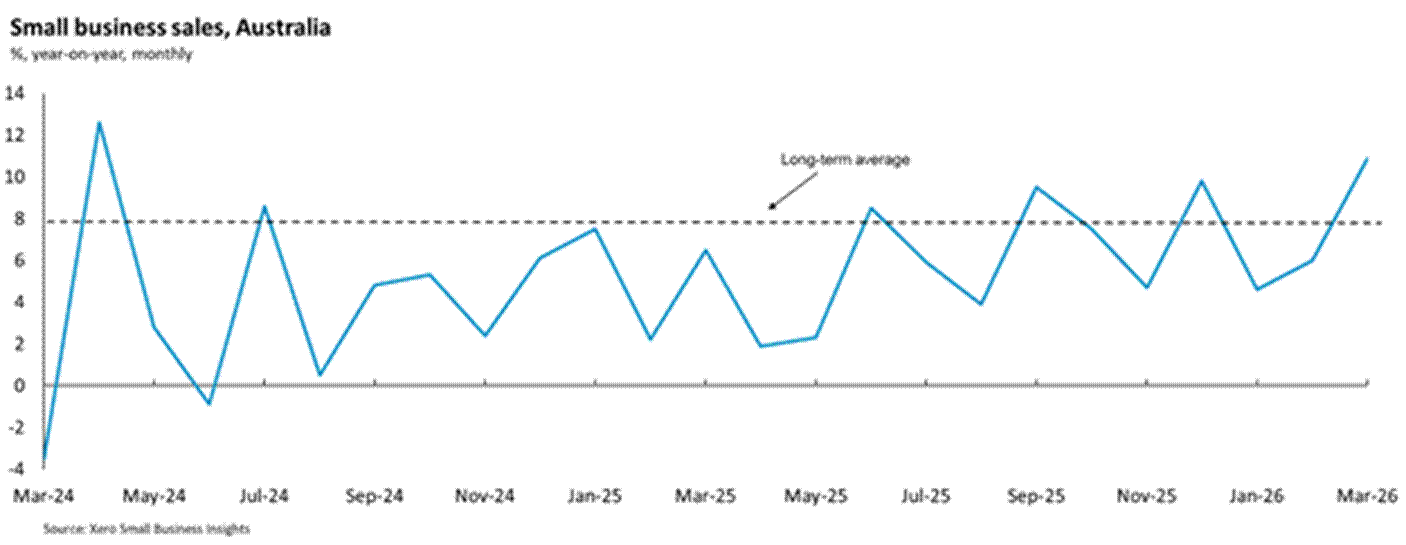
Australian small businesses continued their strong momentum from the end of 2025, with a 7.2% year-on-year increase in sales for the first quarter of 2026 – including a 10.9% y/y spike in March – confirming last quarter’s high was a sustained trend.

The XSBI report, which analyses anonymised and aggregated accounting data from 520,000 Australian small businesses, shows the sector maintained momentum despite back-to-back interest rate hikes and the early weeks of the fuel crisis caused by conflict in the Middle East. Australian small businesses outperformed their peers in the US, the UK, New Zealand, and Canada in Q1.

Australian small businesses March quarter at a glance:

  • Sales rose 7.2% y/y, increasing as the month progressed – rising 4.6% y/y in January, 6.0% y/y in February and surging 10.9% y/y in March
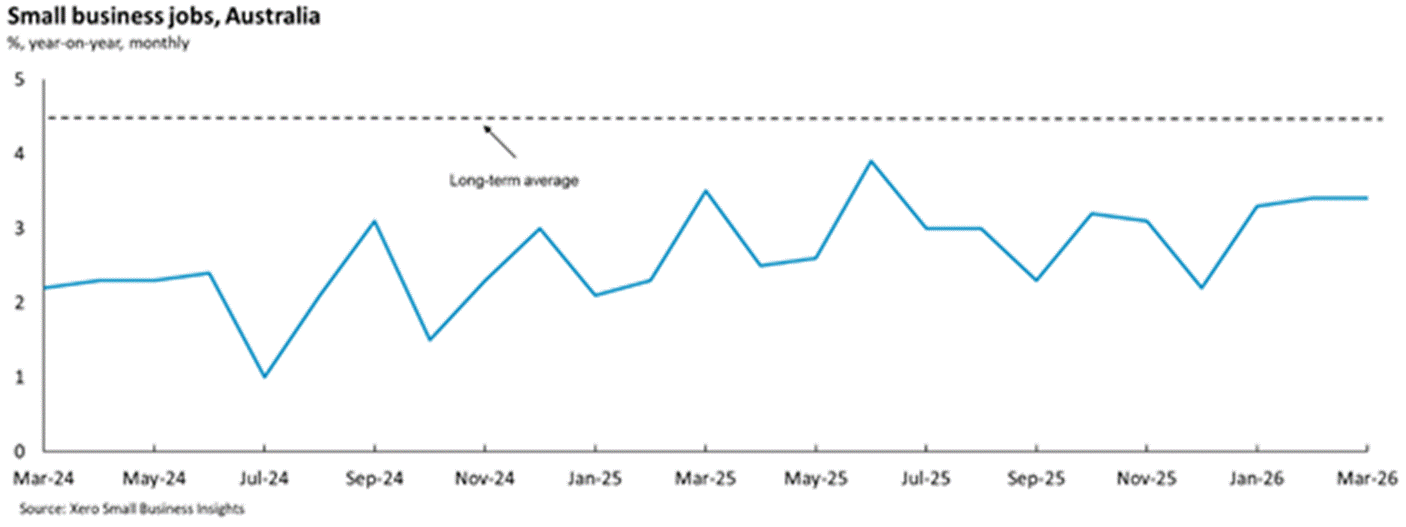
  • Jobs grew 3.4% y/y – increasing from 2.8% y/y in the December quarter
  • Wage growth also increased to 2.7% y/y – up from 2.5% in the previous quarter and just below the historical average of 2.9%
  • Small businesses were paid on average in 24.1 days, holding firm from 24.0 days in the December quarter
  • Construction (+10.4% y/y), healthcare (+9.2% y/y), and financial services (8.8% y/y) were the best-performing industries for sales growth
  • Queensland (+9.8% y/y) and Western Australia (+8.1% y/y) were the best-performing states in terms of sales, with Queensland continuing to have the highest growth rate in the country.

Louise Southall, Economist at Xero, cautioned that this momentum could be at risk if the RBA raises the cash rate in May or if escalating Middle East tensions further disrupt fuel, transport and global supply chains.

Southall pointed to the transport and logistics industry as a possible early warning sign. Higher fuel prices drove increased sales in the sector up 13.2% year-on-year in March. That was up 8.2 percentage points from February, and the largest month-to-month sales rise across all industries tracked by the report.

Southall said: “We can see that small businesses that provide passenger and freight services have already been impacted by higher fuel prices. We are now watching closely to see if and how this inflationary impact bleeds into small businesses providing other goods and services in the coming months and how higher prices could affect overall business activity.”

Price increases contained to fuel as small business sales grow

Ahead of the Australian Bureau of Statistics’ (ABS) household spending release, XSBI data offers an early proxy for consumer spending, showing that price increases to date are largely in fuel only and not broad-based. This suggests first-quarter sales likely reflected a genuine improvement in sales activity rather than being simply due to higher prices (with the exception of the transport and logistics sector in March).

Wages grow but industries still unable to match inflation

Wages rose 2.7% y/y in the three months to March, which is still behind headline inflation of 3.7%, but edging closer to the historical average of 2.9% and reflecting ongoing tight conditions in hiring. Hospitality workers had the largest pay increase in the past year (+3.5% y/y), although this had little impact attracting new workers to the sector, as it continues to experience a skills shortage. Construction also performed well, with wages up 3.3% y/y. Most other industries were around the national average, with the exception of transport and logistics (+2.1% y/y) and information, media and telecommunications (+2.2% y/y)

Australian companies ramp up hiring to start the year

As sales and wages gathered momentum, so too has jobs growth. Jobs grew 3.4% y/y in the March quarter, after a 2.8% increase in the December quarter. Public administration (+5.6% y/y) led the gains, with construction (+5.3% y/y) continuing to be a strong performer. Hospitality (+0.7% y/y) and administrative services (+1.3% y/y) remained the softest industries for jobs growth. As with sales, the best performing states were Western Australia (4.5% y/y) and Queensland (4.1% y/y), with WA continuing to attract talent following its country-leading economic and population growth in 2025.
Southall said: “Small businesses have started 2026 in good shape, with sales, jobs and wages all growing – key metrics the RBA monitors closely for interest rate decisions. Xero’s data is the first insight into how the conflict in the Middle East is impacting small businesses, and so far it hasn’t been as damaging as many feared, despite Australia being one of the countries most reliant on Middle Eastern oil among the markets we track. Importantly, this strength appears to reflect genuine increases in activity rather than price-driven growth, with cost pressures so far largely confined to fuel.”

Angad Soin, Managing Director ANZ & Global Chief Strategy Officer at Xero, said: “The strong XSBI results are good news for small businesses but challenges are still to come – we expect higher fuel costs to increasingly flow through to the price of goods and services across industries in the coming months. For small businesses, it’s an important time to think about your strategy to navigate the ongoing uncertainty. Work with your advisor, pressure test your cash flow, and make sure you have clear visibility of your costs in real time.”

To find out more about how Xero Small Business Insights is constructed, see the methodology.

AI-Based Insurance Quotes

Australian small business owners can now receive and compare business insurance quotes directly inside ChatGPT, in a move that signals a major shift in how financial services are distributed. BizCover Brings Australia’s First AI-Based Insurance Quotes to ChatGPT.

BizCover has become the first business insurance app globally, and the first insurance app of any kind in Australia, to offer SME insurance quoting functionality within ChatGPT’s new GPT Store. This allows Australian business owners to request Public Liability and Professional Indemnity quotes using natural language without visiting a traditional insurance website.

The Sydney-based comparison site secured approval from OpenAI to launch the app, which enables users to describe their business in plain English, enter their postcode, staff numbers and annual turnover and instantly receive indicative pricing from multiple insurers.

BizCover Co-Founder and CEO Michael Gottlieb said search behaviour is changing rapidly with small business owners increasingly using AI tools to research, plan and make purchasing decisions.

“We’ve seen meaningful migration away from traditional search channels. If customers are beginning their journey inside AI platforms, insurance must be available there too,” Gottlieb said.

“Operating inside ChatGPT means small businesses can access comparative insurance insights at the exact moment they are making decisions.”

The app generates indicative quotes from 10 leading insurance partners currently connected to the BizCover platform. AI-Based Insurance Quotes compare:

  • American International Group, Inc. (AIG)
  • Berkshire Hathaway Specialty Insurance Company (BHSI)
  • Berkley Insurance Australia (Berkley)
  • Chubb Insurance Australia Limited (Chubb)
  • DUAL Australia Pty Ltd (DUAL)
  • QBE Insurance (Australia) Limited (QBE)
  • AAI Limited (Vero)
  • Zurich Australian Insurance Limited (Zurich)
  • HDI Global Specialty SE Australian Branch (HDI)
  • The Hollard Insurance Company Pty Ltd (Hollard) 

Transactions and policy purchases occur on BizCover’s secure platform (not within ChatGPT) ensuring compliance with regulatory and data protection requirements..

The launch follows strong global interest after OpenAI approved insurance quoting functionality within ChatGPT, raising questions about the future of more traditional broker and comparison models.

“This is not a chatbot add-on,” Gottlieb said. “It’s a fully embedded quoting pathway operating inside a generative AI ecosystem.”

“We see generative AI as the next interface layer for financial services,” he added.

“Insurance has traditionally relied on websites, comparison portals and intermediaries. AI introduces a new entry point and we intend to lead in that environment.”

“We want business owners to have the ability to transact in the way they want to with the choice they need, whether that’s through traditional search engines, AI,  direct through BizCover or a broker.”

BizCover supports nearly 300,000 Australian small businesses across more than 6,000 occupations and continues to build technology that makes insurance faster, simpler and easier to access.

NetSuite Next AI Innovations to Help Businesses

Oracle NetSuite, the #1 AI Cloud ERP, today announced a series of AI-powered innovations to help organisations in Australia and New Zealand increase efficiency and accelerate growth. The updates will enable customers to take advantage of next-generation capabilities in NetSuite Next, automate and accelerate business processes, improve visibility and decision-making, and achieve faster outcomes.

“NetSuite is committed to delivering a collaborative, insightful, adaptive, AI-first experience that will help our customers in Australia and New Zealand take full advantage of the latest AI innovations,” said Brian Chess, senior vice president of AI, Product, and Technology, Oracle NetSuite. “With embedded AI that respects existing roles, permissions, and business policies, NetSuite helps organisations expand insights, boost productivity, and achieve immediate value from AI.”

A few examples of the latest innovations for customers in Australia and New Zealand include:

  • NetSuite Next: Helps organisations transform finance, operations, and customer engagement by embedding conversational intelligence, agentic workflows, and natural language search throughout NetSuite. With Ask Oracle, a natural language assistant that enables users to search, navigate, analyse, and act across the entire suite, NetSuite Next helps customers turn data into action, automate repetitive and complex tasks, and achieve outcomes faster, more intuitively, and with greater confidence. To learn more, please visit: NetSuite Next.
  • NetSuite AI Connector Service: Helps organisations select the AI assistant that best fits their business needs, define the data the assistant can access, and govern how the assistant interacts with NetSuite. Built on open standards, including the Model Context Protocol (MCP), the AI Connector Service provides a secure way to connect NetSuite with external AI assistants and agent platforms and includes Standard and Custom MCP tools.
  • Project profitability: Helps project-based organisations improve revenue recognition and task management by streamlining project oversight in NetSuite SuiteProjects. In addition, the latest enhancements accelerate issue investigation and resolution by enabling organisations to instantly recalculate revenue plans and providing real-time notifications when project activity impacts revenue.
  • AI-powered inventory narratives: Help organisations quickly understand inventory status with concise, contextual AI-generated summaries that pull data from multiple inventory reports. One of 20+ new AI-generated narrative capabilities across the suite, inventory narratives help organisations quickly surface anomalies such as low or excess stock, identify trends that require attention, and get clearer visibility into back-order risks, inventory activity drivers, and inventory valuation concentrations.
  • NetSuite Warehouse Management enhancements: Help organisations boost efficiency, improve visibility, increase flexibility, and enhance the user experience across warehouse operations. Organisations can search for kit and non-inventory items, automate landed cost validations and purchase order receipt processing, support reversal for inbound shipments, and receive real-time back-order alerts during work order picking.
  • NetSuite Connector for Loop: Helps organisations resolve returns faster and maintain cleaner financial data by automating the flow of returns data from Shopify into NetSuite. For example, organisations can manage refunds and exchanges with greater accuracy and control by automatically creating return authorisations, item receipts, and cash refunds based on Loop workflows and new self-service configuration tools.
  • Enhanced NetSuite Connector for Shopify: Helps organisations keep orders accurate across channels with bidirectional order edit synchronisation for Shopify B2B. As a result, organisations can ensure order changes in NetSuite — including pricing updates, quantity modifications, and line-item edits — are reflected accurately in B2B portals. This helps ensure that buyers see up-to-date information and helps operations teams reduce manual corrections and keep fulfilment, invoicing, and reporting aligned.
  • Enhanced NetSuite Connector for Amazon Seller Central: Helps organisations improve accounting accuracy and simplify reconciliation by automatically bringing payment and deposit data from Amazon directly into NetSuite. In addition, to help support auditability and revenue recognition alignment, the enhanced connector ensures full, partial, and split payments are mapped to the correct order or invoice.

Availability

NetSuite Next will be available to customers in Australia within the next 12 months. All other updates are now available.

Regular customers generate five times more revenue

Loyal regular customers are reshaping how small businesses grow in Australia’s suburbs, new data from Square’s 2026 Local Economy Report shows. 

With stubborn inflation and ongoing interest rate pressure weighing on household spending, most Australians expect their local spending to hold steady this year. In that environment, growth will not come from larger sales. It will come from customers returning more often and spending little and often.

This could be good news for local neighbourhood businesses, with Square’s data showing customers who return regularly generate five times more annual revenue than those who visit once and do not come back.

One-off customers often spend more in a single visit, in some cities nearly double the average transaction of a regular. But over the course of a year, repeat visits add up.

On average, a regular visits a business 12 times a year. It is that steady rhythm, not the one-off splurge, that is driving resilience in the suburbs.

The neighbourhood effect

Loyal customers don’t just support one business; they strengthen the entire neighbourhood. 

Square’s analysis shows local businesses increasingly share the same regular customers. Nearly three in four Australians now buy from a local retailer or restaurant within their postcode at least once a week. Most make multiple stops in a single neighbourhood trip. The café regular is often also the wine bar regular. The salon client is shopping at the boutique down the road. When one business builds loyalty, others nearby often benefit too.

“The suburbs operate differently to the CBD,” said David Schnabl, Head of Account Management at Square in Australia. “City centres depend on traffic while neighbourhoods depend on loyalty. When customers are spending most of their time and money close to home, one strong business can lift the others around it.”

That shift towards everyday local trade is something operators are actively planning for when opening new venues.

“When we look for a venue, we generally find the location first and then we tailor our brand to what’s needed in the area,” says Mike Ico, co-founder of Marrickville-based Superfreak, Soulmate & Splash. “We’re lucky because we live in the areas where we open our cafes. We think it’s better to open in a residential area because you get that everyday trade – and you also have that community from all the local neighbours.” 

Building loyalty over chasing bigger sales

With 68 percent of Australians expecting their local shopping and dining habits to remain steady this year, the opportunity lies in deepening relationships with existing customers, not waiting for a surge in new ones.

Square’s data shows tools that help businesses stay connected to regulars materially increase return custom. In 2025, 93 percent of Australian sellers using Square email marketing and loyalty features had regular customers, compared to just 39 percent of Square sellers without those tools. Sellers using marketing products such as loyalty or email saw on average four times more daily transactions and three times more daily spend.

This is reflected in consumer sentiment, with  more than a third saying a digital loyalty program would make them more likely to frequent a local business.

One business that’s been seeing the benefit of implementing a digital loyalty program is Suupaa, a Japanese convenience style restaurant in Melbourne’s Cremorne neighbourhood.

“People really value a loyalty system,” said Stefanie Breschi, co-founder of Suupaa. “When customers feel recognised and rewarded, they come back more often. We’ve seen first-hand how building those relationships turns occasional shoppers into regulars.”

Schnabl said the lesson for small businesses is clear.

“Right now, with businesses feeling the pressure, it’s tempting to chase the bigger sale. But the data shows it’s the regular who really matters: someone who pops in every week is far more valuable than someone who splurges once and doesn’t come back. The smart play in 2026 is simple: give people a reason to return.”

Neighbourhoods are settling into a new rhythm

In a tighter economy, Australians are being more deliberate about where they spend. And their local neighbourhoods are the main beneficiaries.

Spending close to home is becoming routine rather than reactive. Local cafés, retailers and service providers are part of weekly habits, not occasional indulgences. When one business earns a regular, it often strengthens the broader strip around it.

For small businesses, the direction is clear. The opportunity in 2026 isn’t to chase unpredictable foot traffic; it’s to become dependable, familiar and woven into the everyday lives of customers.

Schnabl said that should give operators confidence.

“Despite the economic pressure, Australians haven’t turned away from local businesses. They’re building habits around them,” he said. “If you focus on consistency, fair value and genuine connection, loyalty compounds. The suburbs aren’t slowing down: they’re finding their rhythm. And the businesses that become part of that rhythm will be the ones that thrive.”

You can view the full report here

“The Pitch,” a $15M Global Tournament to Find the Next Generation of Borderless Founders 

Australian business leaders can share in a global pool of $15 million USD, as Deel, the leading global HR and payroll platform, launches The Pitch, an international competition designed to identify, elevate, and fund the world’s most promising seed-stage startups. 

Leveraging Deel’s global footprint, the program aims to level the playing field for founders by surfacing talent based on merit, rather than geography or connections. 

The Pitch will engage over 20,000 startups across seven global regions, culminating in a total investment pool of up to $15 million. Up to 100 regional winners will receive $50,000 in investment each, while up to ten global champions will receive a $1 million investment each, to scale their visions. 

“What we know is that local networks often constrain traditional venture capital. The Pitch breaks these boundaries by combining a high-stakes tournament with expert review that analyses a broad range of data points to identify “high-signal” startups,” said Deel Country Manager Shannon Karaka. 

“Talent is global, but access to capital isn’t. The Pitch surfaces the best ideas regardless of a founder’s location or connections,” Mr Karaka said. 

“One thing I’ve learnt from local founders is: the hardest part isn’t the idea, it’s believing it’s worth backing when no one else does.” 

“That’s why I’m excited about The Pitch. It’s not about perfect decks or polished storytelling. It’s about giving early-stage founders a genuine opportunity to be heard. If you’re building something and wondering whether it’s ‘too early,’ it probably isn’t.” 

The competition is headline sponsored by JP Morgan, in addition to a16z, dLocal, Google, Mubadala, Orrick, Prodware, Ribbit Ventures, and Stripe. 

For more details and instructions on how to apply visit the Deel Pitch page.  

Government expands anti-money laundering laws 

Thousands of small and medium-sized enterprises (SMEs) face being hit by a cash flow crunch as a result of new regulatory compliance measures stemming from the Federal Government’s expansion of Anti-Money Laundering laws and Counter-Terrorism Financing (AML/CTF) laws to a range of Australian businesses. 

From 1 July 2026, a new cohort of SMEs – which include accountants, lawyers, conveyancers, real estate agents and jewellers – must implement risk-based compliance programs, monitor transactions, verify customers and maintain detailed records for up to seven years, as well as appoint dedicated compliance officers under the updated AML/CTF laws. 

Chief Legal Officer at leading non-bank lender Banjo Loans Matt Boglis says the reforms, aimed at closing gaps in Australia’s financial crime framework, carry immediate operational and financial pressure for SMEs. 

“For businesses that have never operated under these rules, compliance is more than a regulatory hurdle. It’s a real cash-flow and staffing challenge,” Mr Boglis said.  

“They need systems, processes, trained people and ongoing oversight. Without planning, it could tie up working capital and distract from growth.”   

He says the timing adds urgency, with existing regulated entities required to implement changes by 31 March 2026 and finalise programs by 30 June. Newly regulated businesses must comply by 1 July 2026, despite enrolment only opening on 31 March. 

Beyond operational strain, Banjo Loans warns that compliance, or lack thereof, will increasingly influence funding. Lenders are expected to treat AML/CTF readiness as a key factor in risk assessment, meaning non-compliant businesses could face difficulty securing loans or investment. 

“Compliance is now part of how lenders evaluate a business’s credibility and growth potential,” Mr Boglis said.  

“Getting it wrong doesn’t just risk fines. It can hit a business where it hurts most – access to capital.”  

He says that despite the short-term burden, the long-term benefits are clear, with early compliance strengthening governance, reducing exposure to financial crime and signalling credibility to lenders, clients and partners. 

“These reforms will reshape risk management for SMEs. Those who act early will emerge stronger, more credible and better positioned for growth,” Mr Boglis said.  

D-Link DWM-314-G 5G Dual SIM M2M VPN Router

D-Link A/NZ has launched the DWM-314-G 5G Multi-Connect Dual SIM M2M VPN Router which unleashes and uses the power of 5G for superior machine-to-machine (M2M) connectivity.


The DWM-314-G 5G Multi-Connect Modem harnesses 5G technology to accelerate ultra-fast speed, reduce latency and ensure reliable connectivity with its automatic failover feature enhancing M2M communication.

Ideal for smart parking poles, kiosks and ATMs, this modem supports real-time data transfer and remote management. A built-in 4-port Gigabit Ethernet switch expands the scope of the unit across a wide variety of use-cases and applications, saving costs and making it perfect for space-constrained environments.

Additionally, secure VPN capabilities safeguard data transmission, ensuring robust security for all connected devices.

Designed for instant setup, the DWM-314-G 5G modem offers real-time remote access and uninterrupted connectivity over long distances. Equipped with dual SIM slots, users simply insert two Micro-SIM cards (3FF) for a reliable connection to a high-speed 5G network with seamless 4G/5G switching and for failover redundancy if one carrier network is down.

Convenient wall and DIN-rail mounting options allow the DWM-314-G to be mounted virtually anywhere. As a result, this plug-and-play modem ensures robust service even in challenging environments.

The industrial-grade casing provides reliable high-speed connectivity in extreme conditions. With a corrosion-resistant zinc-plated steel case with wide operating temperature range and high humidity tolerance means that the DWM-314-G is ready for the most demanding M2M applications in virtually any environment.

The DWM-314-G 5G Multi-Connect Modem offers effortless integration with its 4G/5G Cellular and Ethernet interfaces, providing instant access for Ethernet-enabled devices without any need for pre-configuration or special software and this plug-and-play capability makes it ideal for versatile applications.

It extends wired connectivity to many devices ensuring it can be easily integrated into diverse settings including parking lots, retail shops, surveillance systems and service stations.

It can also be used for Smart Bus Stops providing remote access for real-time bus information and ad updates, enhancing commuter experience.

For tailored configurations, the device’s web interface is user-friendly and readily adjustable through any standard web browser.

Key features of the DWM-314-G 5G Multi-Connect Dual SIM M2M VPN Router

• 5G SA & NSA speeds of up to 3.4 Gbps1 for Internet access and data transfer​

• 4 GbE LAN ports ensure reliable connectivity and reduces extra hardware costs

• Plug & Play design for quick and easy integration​​

• Durable zinc-plated steel case is corrosion-resistant to ensure device longevity​​

• -30 to 70°C operating temperature to resist harsh environments​​

• Wall or DIN-rail mounting allow for optimal device placement​


The new DWM-314-G 5G Multi-Connect Dual SIM M2M VPN Router is available now from www.dlink.com.au and all authorised D-Link resellers and partners in Australia for the RRP of AU$1249.95

CyberPower lightweight, short depth UPS systems

CyberPower’s new Rackmount UPS (uninterruptible power supply) models, the latest in the company’s PFC (power factor correction) Sinewave UPS series have recently won the International Tech Innovator Award, ESA Innovation Award and been finalists in the ISE Network Innovator Award and Product of the Year Award.

The new UPS systems are designed with energy-efficient, line-interactive topology and provide battery backup, surge protection and EMI/RFI noise filtering to protect security systems, audio/visual equipment, networking and storage devices, workstations and entertainment systems from power fluctuations and outages.

The PFC Sinewave UPS systems, which CyberPower debuted in 2010, feature sine wave backup power to protect sensitive electronics requiring Active PFC-power source compatibility.

In addition, CyberPower PFC Sinewave UPS systems include automatic voltage regulation (AVR) technology which stabilises incoming AC signal to maintain output power by controlling low voltages without using battery power, therefore prolonging the life of the battery.


The newest CyberPower CP1600EIPFCRM2U UPS system is ideal for security system administrators, IT professionals, small-business owners, schools, and consumers who need to ensure uptime of their equipment.

The unit’s short depth and light weight is well suited for wall-mount racks and smaller spaces. The easy-to-read colourised LCD control panel and remote management and monitoring options create a user-friendly experience for end users.

With the Australian market for compact UPS systems growing rapidly, the new CP1600EIPFCRM2U presents a significant number of benefits for users.


Features of the new CyberPower CP1600EIPFCRM2U Rackmount UPS system include:

• EMI/RFI noise filtering: ideal for security systems and audio/video equipment, maintains clean power for connected equipment by filtering out electromagnetic and radio frequency interference to ensure picture and sound quality.

• Easy installation and fit: the unit is lightweight at 12.8kg which is 50 percent lighter when compared to typical rackmount UPS systems with similar VA ratings and wattage and 35 percent shorter at 27.4cm.

• Remote monitoring and management of the UPS is available with optional RMCARD205, RCCARD100 or RWCCARD100 via expansion card slot.

The unit is compatible with CyberPower’s PowerPanel® power management software, providing advanced UPS controls such as scheduled shutdown/reboot and email notifications. PowerPanel is available as a free download for the CP1600EIPFCRM2U and all other compatible CyberPower UPS systems at https://www.cyberpower.com/au

There are six new models in the PFC Sinewave Range – three 1U models and three 2U models.

The three 2U Models are the CP1200EIPFCRM2U, CP1600EIPFCRM2U and the CP2000EIPFCRM2U.

For more information on these new 2U models go to:

CP1200EIPFCRM2U

CP1600EIPFCRM2U

CP2000EIPFCRM2U

The three 1U Models are:

CP700EIPFCRM1U

CP1000EIPFCRM1U

CP1500EIPFCRM1U

For more information on all the products in the PFC Sinewave Range go to: https://www.cyberpower.com/au/en/product/series/pfc_sinewave_(e)#models

eSIM to stop hacking and big data roaming fees

As people increasingly look for ways to stay safe from hackers and avoid horrendous roaming fees, eSIM specialist Simify is witnessing its eSIMs and unlimited roaming data plans on essential pre-flight checklists for travellers heading overseas this summer, more so than ever before.

Taking advantage of school holidays and end-of-year breaks, more Australians travel overseas in December and January than at any other time of year, according to the Australian Bureau of Statistics.

When practically every traveller has a smartphone in their pocket alongside their passport, it’s no surprise that summer is also peak season for eSIMs.

eSIM technology is embedded directly in smartphones and tablets, allowing users to easily switch between mobile networks as they travel. This makes it simple for international travellers to access affordable high-speed mobile data, without the need to juggle physical SIM cards or switch phone numbers.

The convenience of eSIMs is perfect for families heading overseas for the summer break, making it easy and affordable to keep everyone online, says Aidan Butler, co-founder of Simify.

Simify offers mobile coverage in more than 150 countries, providing international travellers with peace of mind: unlimited data for up to 90 days, with no need to worry about top-ups or extra roaming fees.

Waiting until you land before organising your eSIM risks getting stung with hefty international roaming fees, warns Butler.

“A few countries prevent tourists from purchasing foreign eSIM services after they arrive in the country,” he says.

“Things can change very quickly, so it’s safer to get your eSIM up and running before you fly, rather than risk getting caught out at the other end.”

Along with avoiding oppressive international roaming fees, Butler says savvy Australians also recognise the importance of eSIMs for staying safe.

“Summer is our busiest time of year as Australians flock overseas, but the smart ones know that eSIMs aren’t just about saving money,” he says.

“People are waking up to the fact that public WiFi isn’t safe anymore, so they’re taking advantage of unlimited eSIM plans to avoid relying on dodgy WiFi when they travel.”

Even connecting to secure hotel WiFi can be risky, as 58 per cent of hotel cybersecurity leaders reported five or more cyberattacks during the 2024 peak travel season, according to Hospitality Net’s 2024 Cybersecurity in Hotels Report.

Today’s unlimited eSIM travel plans mean that travellers can always stay online using secure mobile data. As a bonus, they can keep their Australian mobile number active to receive important messages, such as verification codes from their bank.

“Cybersecurity threats are constantly evolving; you just can’t be sure whether any WiFi network is really legit and secure,” Butler says.

“You’re paying a very high cost for so-called free public WiFi if your bank account gets cleaned out when you’re travelling abroad.” 

For details on all of Simify’s eSIM unlimited roaming data plans, go to: https://simify.com

Jabra Collaboration with Zoom to Support AI tools

Jabra has announced that it has teamed up with Zoom to achieve new certifications for its professional headsets, underscoring their shared commitment to empowering both frontline and hybrid workers with communication tools that help them stay connected and productive in any environment.

Jabra Perform 75: Certified for Zoom Workplace for Frontline

Zoom announced its new Workplace for Frontline platform in April 2025 to better serve the 80 percent of the global workforce that operates on the frontline. The Jabra Perform 75 mono headset is now the first audio device to be certified for that program. Designed for employees who spend their workdays on the move, Jabra Perform 75 integrates with Zoom Workplace to keep teams connected, hands-free and more focused during every shift.

Zoom Workplace for Frontline combines on-shift communications and work management, giving frontline teams tools for chat, calling and push-to-talk (PTT), shift scheduling and reporting. Paired with Jabra Perform 75, frontline workers gain easier access to these tools, remaining heads-up, hands-free, and comfortable throughout their shift, while managers benefit from task overviews and attendance insights that keep operations running smoothly.

AI at the Core of Collaboration

Zoom AI Companion is a generative-AI digital assistant, that delivers powerful, real-time capabilities to help users improve productivity and work together more effectively. With this certification news, Jabra plays a key role in ensuring that frontline workers can interact with Zoom’s AI features through clear, accurate voice input and dependable audio performance. This collaboration helps make AI-driven communication practical and effective in busy, real-world environments.

Jabra Evolve2 75: Certified as a Zoom Native Bluetooth Headset

In addition, the Jabra Evolve2 75 professional headset has been certified as a Zoom Native Bluetooth Headset. This headset enables workers to enjoy the full Zoom collaboration experience without the need for a dongle. The result is greater flexibility and consistent performance for teams who depend on straightforward tools to stay connected.

Janne Jakobsen, SVP for Enterprise Headsets at Jabra said: “These certifications mark a special milestone for our collaboration with Zoom. Users can trust that our headsets deliver not only premium sound and comfort but also full compatibility with Zoom, the platform they rely on every day. Together, we are enabling an even better experience for mobile professionals worldwide.”

Key Features of the Jabra + Zoom Collaboration

Jabra Perform 75: Certified for Zoom Workplace for Frontline

  • Hands-free Bluetooth headset built for shiftwork, helping associates stay connected and focused
  • Noise-cancelling microphone technology that blocks out 99% of background noise for clearer conversations in busy environments
  • Modular design with hot-swappable battery and easy pairing for smooth shift handovers and uninterrupted performance
  • Lightweight comfort with cushioned earcups and multiple wearing styles, seamlessly integrated with Zoom Chat, push-to-talk, task management and scheduling tools for both associates and managers

Jabra Evolve2 75: Certified as a Zoom Native Bluetooth Headset

  • Enables seamless connectivity without a dongle
  • Delivers dependable, flexible performance for teams who need effective tools to stay connected


Eric Yu, Head of Hardware Partnerships , at Zoom said: “Our goal is to provide users with the best possible tools for their daily work. By certifying Jabra’s headsets, we make it easier for mobile professionals using these Jabra products to enjoy seamless connectivity,  and the confidence of full Zoom Workspace performance.” For more details on these certifications, visit the Jabra blog: First in the industry. Twice the impact. Jabra innovation gets Zoom certification.