Call for certainty on stalled tax measures

With the Treasurer positioning productivity and tax reform at the heart of the Federal Budget 2026–27, The Tax Institute is calling for urgent action on several announced but unenacted measures that continue to create uncertainty and increase compliance costs for taxpayers and practitioners.

Some of these measures were announced during the last term of Parliament, and others were announced many years ago. In some cases, there is little more than a media release; in others, the Government has released a consultation or discussion paper. But in all cases, no new law has been enacted, even though some measures have announced start dates that have already passed. The Tax Institute urges the Government to confirm whether these measures will progress or be abandoned, so taxpayers and practitioners can plan with confidence and certainty.

The Tax Institute’s Head of Tax and Legal, Julie Abdalla, FTI, says: “There is a pattern of inaction, of promising taxpayers change and not following through. Time and time again, we’ve seen tax measures promised in Federal Budget announcements that are then ignored for years. Until the government resolves the long list of outstanding

measures and establishes a process for ongoing system maintenance, we will not see real progress on the productivity agenda or efforts to cut red tape.”

“If the government does not intend to proceed with certain announced measures, they need to come out and say so explicitly.”

“We would like to hear genuine tax reform announced in the upcoming Budget. But more than that, taxpayers need to know that what’s announced will actually be delivered in an effective and timely manner.”

Among many important unresolved matters, some of the key announced, but unenacted measures are:

Large Business and International

Corporate tax residency reforms, announced in the Federal Budget 2020-21 following recommendations from the Board of Taxation, remain unlegislated despite strong industry support. In making its recommendations, the Board of Taxation found that the existing rules are ‘out of step with modern business practices, create considerable uncertainty, are susceptible to manipulation and increase the potential for international disputes’. As a consequence, many corporations are experiencing a significant increase in financial costs and disruptions to business.

The Government’s proposal to strengthen the foreign resident capital gains tax regime, announced in the Federal Budget 2024–25, has also stalled. Although the Treasury released a consultation paper in July 2024, no progress has been made since then. The measure would broaden the range of assets subject to CGT. In an environment of already heightened investor nervousness, the uncertainty of whether or when this measure will proceed is a further constraint on investment.

Proposed updates to Part IVA, announced in the Federal Budget 2023–24 and later deferred in the Federal Budget 2024–25, remain unlegislated. These changes would expand the general anti‑avoidance rules to apply to certain cross-border transactions. Again, the uncertainty of which transactions this measure might apply to, and when, is an impediment to investment.

Similarly, the Government’s announcement in May 2024, as part of the Federal Budget 2024–25, of a new penalty regime for mischaracterised or undervalued royalties for large multinationals has not progressed. This is proposed to apply from 1 July 2026.

Further, in the Mid-Year Economic and Fiscal Outlook 2024–25, the Government expanded the penalty framework by announcing a measure that proposes to penalise large taxpayers that mischaracterise or undervalue interest or dividend payments to which withholding tax would otherwise apply. This measure is also supposed to commence on 1 July 2026.

Finally, on 13 March 2025, the Government announced proposed amendments to the Managed Investment Trust (MIT) regime to clarify that trusts ultimately owned by a single widely held institutional investor (such as a foreign pension fund) can continue to qualify for MIT withholding tax concessions, following the ATO’s release of Taxpayer Alert TA 2025/1. The measure is proposed to apply to fund payments from 13 March 2025, but has not yet been enacted.

Fringe Benefits Tax

The Government has not confirmed whether it will proceed with consultation on FBT car parking benefits, originally announced in March 2022 following the Full Federal Court’s decision in Commissioner of Taxation v Qantas Airways Limited [2014] FCAFC 168. Employers remain uncertain about their obligations. This uncertainty has been compounded by the Federal Court decision in Toowoomba Regional Council v Commissioner of Taxation [2025] FCA 161, in which the Court held that a shopping-centre car park was not a ‘commercial parking station’ for FBT purposes because it was not operated commercially for profit. The Commissioner has appealed this decision. As a result, ongoing ambiguity remains for employers seeking certainty in the treatment of car parking fringe benefits.

Small businesses

The Division 7A deemed dividend rules remain one of the most complex and confusing areas of tax law. Yet targeted amendments announced in the Federal Budget 2016-17 and consulted on in 2018 remain unresolved.

The former government originally announced on 3 May 2016, as part of the Federal Budget

2016–17, that it would make legislative reforms to improve the integrity and operation of Division 7A following a consultation process conducted by the Treasury. Since then, the proposed reforms to Division 7A have been deferred multiple times, resulting in ongoing uncertainty and continued high compliance costs for taxpayers.

The reforms to Division 7A proposed in the Consultation Paper released on 22 October 2018 are based on recommendations by the Board of Taxation and include the following:

● simplified Division 7A loan rules to make it easier for taxpayers to comply with the provisions;

● a self-correction mechanism to assist taxpayers to promptly rectify breaches of Division 7A without having to apply for the Commissioner’s discretion;

● safe harbour rules relating to the use of assets that would provide certainty and simplify compliance for taxpayers;

● technical amendments to improve the integrity and operation of Division 7A while providing increased certainty for taxpayers; and

● clarification that the unpaid present entitlements of corporate beneficiaries of a trust fall within the scope of Division 7A.

Individuals

Reforms to individual tax residency, announced in the Federal Budget 2021–22, have not progressed despite a 2023 consultation paper. The outdated rules continue to create uncertainty for globally mobile individuals.

The Government’s proposal in the Federal Budget 2020–21 to allow deductions for education and training expenses unrelated to current employment has also stalled since the Treasury’s 2020 consultation.

A $1,000 instant tax deduction for work‑related expenses, announced during the 2025 Federal election campaign, has not advanced beyond its initial announcement, though it is expected that this measure is likely to be reannounced in the upcoming Budget.

Superannuation

Proposed changes to relax residency requirements for SMSFs, announced in the Federal Budget 2021–22 and deferred in the Federal Budget 2022–23, remain unimplemented. The reforms would allow trustees to temporarily relocate overseas for up to five years and remove the active member test.

Tax Administration

The proposal in the March Federal Budget 2022–23 to enable monthly or quarterly electronic lodgement of Taxable Payments Reporting System data has not progressed, despite its potential to streamline compliance.

Similarly, funding announced in the March Federal Budget 2022–23 to support data sharing of Single Touch Payroll information between the ATO and State and Territory Revenue Offices has not advanced.

Awaiting government response on Board of Taxation’s final reports

The Board of Taxation has undertaken several Reviews to which the Government has not yet responded. The Tax Institute is of the view that the Government should respond to and commence detailed and meaningful consultation on the implementation of key recommendations contained in these Reviews, without further delay. The outstanding Reviews include:

● Review of capital gains tax (CGT) rollovers

● Report introducing an asset merger rollover relief

● Review of the income tax treatment of certain forms of deferred consideration ● Fringe Benefits Tax Compliance Cost Review

These Reviews each involve a significant investment of time, expertise and effort by the Board of Taxation and the many stakeholders who contribute through submissions and technical consultation. They are essential for identifying issues in the tax system and opportunities for improvement. Leaving these Reports without response or action undermines that collective work and delays reforms that would benefit taxpayers and the broader economy.

Call to action

The Tax Institute calls on the Government to clearly state which announced but unenacted measures will proceed, and which will not, so taxpayers and their advisers can operate with the certainty they need.

“We’ve identified fourteen significant tax measures that have been stuck in limbo for years, creating ongoing uncertainty and complexity for taxpayers, and the list goes on. Worse still, that’s not including the various reviews undertaken by the Board of Taxation and as yet left unanswered by the government. That’s not good enough, and the government needs to be

held to account on these matters.”

Snapshot of selected announced but unenacted measures

MeasureAnnounced Latest update Current status
Corporate tax residency reformsFederal Budget No changes Unresolved 2020-21 (October 2020)
Proposal to strengthen the foreign resident capital gains tax regimeFederal Budget Deferred in Unresolved 2024-25 Federal Budget 2025-26
Proposed updates to Part IVAFederal Budget Deferred in Unresolved 2023-24 Federal Budget 2024-25

Penalty regime for mischaracterised or undervalued royalties

Federal Budget 2024-25

No changes Unresolved, but proposed to

for large multinationalsapply from 1 July 2026
Penalties for large taxpayers that mischaracterise or undervalued interest or dividend payments to which withholding tax would otherwise applyMYEFO 2024-25 No changes Unresolved, but proposed to apply from 1 July 2026
Proposed amendments to the Managed Investment Trust (MIT) regimeMarch 2025 No changes Unresolved, but proposed to apply from 13 March 2025
Consultation on FBT car parking benefitsMarch 2022 No changes Unresolved
Division 7A deemed dividend rule amendmentsFederal Budget Consulted Unresolved 2016-17 paper released in 2018
Reforms to individual tax residencyFederal Budget Consultation Unresolved 2021-22 paper released in 2023
Proposal to allow deductions for education and training expenses unrelated to current employmentFederal Budget Consultation Unresolved 2020-21 paper released in 2020
A $1,000 instant tax deduction for work‑related expenses2025 election No changes Unresolved campaign
Proposed changes to relax residency requirements for SMSFsFederal Budget Deferred in Unresolved 2020-21 Federal Budget 2022-23
Proposal to enable monthly or quarterly electronic lodgement of Taxable Payments ReportingMarch Federal No changes Unresolved Budget 2022–23
System data 
Funding to support data sharing of Single Touch Payroll information between the ATO and State and Territory Revenue OfficesMarch Federal No changes Unresolved Budget 2022–23

AI-Based Insurance Quotes

Australian small business owners can now receive and compare business insurance quotes directly inside ChatGPT, in a move that signals a major shift in how financial services are distributed. BizCover Brings Australia’s First AI-Based Insurance Quotes to ChatGPT.

BizCover has become the first business insurance app globally, and the first insurance app of any kind in Australia, to offer SME insurance quoting functionality within ChatGPT’s new GPT Store. This allows Australian business owners to request Public Liability and Professional Indemnity quotes using natural language without visiting a traditional insurance website.

The Sydney-based comparison site secured approval from OpenAI to launch the app, which enables users to describe their business in plain English, enter their postcode, staff numbers and annual turnover and instantly receive indicative pricing from multiple insurers.

BizCover Co-Founder and CEO Michael Gottlieb said search behaviour is changing rapidly with small business owners increasingly using AI tools to research, plan and make purchasing decisions.

“We’ve seen meaningful migration away from traditional search channels. If customers are beginning their journey inside AI platforms, insurance must be available there too,” Gottlieb said.

“Operating inside ChatGPT means small businesses can access comparative insurance insights at the exact moment they are making decisions.”

The app generates indicative quotes from 10 leading insurance partners currently connected to the BizCover platform. AI-Based Insurance Quotes compare:

  • American International Group, Inc. (AIG)
  • Berkshire Hathaway Specialty Insurance Company (BHSI)
  • Berkley Insurance Australia (Berkley)
  • Chubb Insurance Australia Limited (Chubb)
  • DUAL Australia Pty Ltd (DUAL)
  • QBE Insurance (Australia) Limited (QBE)
  • AAI Limited (Vero)
  • Zurich Australian Insurance Limited (Zurich)
  • HDI Global Specialty SE Australian Branch (HDI)
  • The Hollard Insurance Company Pty Ltd (Hollard) 

Transactions and policy purchases occur on BizCover’s secure platform (not within ChatGPT) ensuring compliance with regulatory and data protection requirements..

The launch follows strong global interest after OpenAI approved insurance quoting functionality within ChatGPT, raising questions about the future of more traditional broker and comparison models.

“This is not a chatbot add-on,” Gottlieb said. “It’s a fully embedded quoting pathway operating inside a generative AI ecosystem.”

“We see generative AI as the next interface layer for financial services,” he added.

“Insurance has traditionally relied on websites, comparison portals and intermediaries. AI introduces a new entry point and we intend to lead in that environment.”

“We want business owners to have the ability to transact in the way they want to with the choice they need, whether that’s through traditional search engines, AI,  direct through BizCover or a broker.”

BizCover supports nearly 300,000 Australian small businesses across more than 6,000 occupations and continues to build technology that makes insurance faster, simpler and easier to access.

Superhero Streamers® mobilises for cancer research

Game On Cancer®, a Cure Cancer initiative, is calling on all Australian content creators to join Superhero Streamers® 2026. From 1 April to 31 May, streamers can sign up in minutes, keep streaming what they already love, and rally their community to fund cancer research, with a toolkit and campaign support available for creators of all sizes.

Streamers can fundraise solo or join a team, with campaign leaderboards and milestone moments to help build momentum across April and May.

“Streamers and content creators have an incredible ability to bring people together, build community, and spark generosity at scale,” said Vanessa Barry, CEO of Cure Cancer. “Superhero Streamers® is about harnessing that energy to help early-career researchers test brave new ideas that could change outcomes for people affected by cancer. We’re proud to welcome creators from gaming, tech, cosplay, music, art, tabletop, crafting, cooking, fitness, and everything in between.”

Designed to be low-lift for creators, Superhero Streamers® makes it easy to participate regardless of audience size, with toolkits and campaign support available throughout April and May.

Superhero Streamers® 2026 is supported by GeForce NOW Powered by CloudGG, an NVIDIA GeForce RTX-powered cloud gaming service, operated in Australia by Pentanet. Pentanet is providing a prize pool of 6-month GeForce NOW Powered by CloudGG Ultimate membership codes as rewards throughout the campaign. With an Ultimate membership, gamers can stream the latest PC games they already own straight from the cloud — without having the latest hardware — at GeForce RTX-4080 class performance on nearly any device, with over 2,100 supported games in the cloud.

“The power of the Aussie streaming and gaming community to come together for a cause is truly inspiring, and Superhero Streamers® is a perfect example of that,” said Christian Polson-Brown, Marketing Manager at Pentanet. “GeForce NOW Powered by CloudGG is proud to support Cure Cancer, helping to empower creators and communities across Australia to stream and play for something bigger.”

Headlining the Superhero Streamers® 2026 line-up is Camomo, one of Twitch’s best-known Rust creators, alongside Twitch Partner JackHuddo, recognised for GTA roleplay and Old School RuneScape streams; Team Starkk, a collective of Aussie variety streamers known for rallying their communities around big charity pushes; StoneyAU of Stoneys Battlegrounds, esports caster and community builder across Apex Legends and Valorant;peaachxo, a Melbourne-based variety streamer bringing “chaotic cosy” energy; and SplitThePartyTV, loved for tabletop RPG actual plays and community storytelling.

Streamers can join Superhero Streamers® by:

look for teammates: https://discord.gg/KKjwzNGEgd

  • Choosing a stream date (solo or as part of a team)
  • Going live and inviting your community to donate

Funds raised help brilliant emerging researchers test groundbreaking new ideas sooner, so promising discoveries can move faster.

More streamer announcements and fundraising milestone rewards will roll out across March, with campaign moments designed to help streamers build hype and bring their communities along for the ride. More details at gameoncancer.com.au.

Not a streamer? Watch participating streams throughout April and May and donate via Tiltify to support cancer research.

Looking to sponsor? Fundraising milestone rewards will roll out across March and April, including GeForce NOW Powered by CloudGG incentive prizes. Game On Cancer® also welcomes kind rewards, or creator enablement.

1 in 3 to raid personal savings as Payday Super for cash flow

Late payments are the biggest threat to Payday Super compliance, with 84% of Australian small business owners warning that delayed customer payments could force them to miss deadlines, according to new research from global small business platform Xero.

The survey of 500 employing Australian small businesses reveals they lost $15,257 on average over the last financial year due to late payments from customers. The shift to more frequent super payments is set to compound cash flow pressures across the sector. 

While an overwhelming 91% of small businesses are supportive of Payday Super as a positive change for employees, 87% say paying super more frequently will put pressure on their cash flow. More than half (58%) cite customer payments as their biggest challenge to managing ongoing cash flow, closely followed by rising cost pressures (57%). 

The strain is already personal. Almost one third (31%) expect to dip into personal savings to meet compliance obligations, while 31% anticipate needing to borrow money. Others plan to delay paying business expenses (41%), or delay paying themselves (38%) to manage the strain.

Payday Super research Key findings:

  • 84% say late payments could prevent Payday Super compliance
  • $15,257 lost by small businesses on average over the last financial year due to late payments 
  • 31% expect to dip into personal savings to meet obligations
  • 82% anticipate delaying growth or investment plans in 2026

Angad Soin, Managing Director ANZ and Global Chief Strategy Officer at Xero, said: “When one in three small business owners say they may need to use personal savings to meet Payday Super obligations, it’s clear this change is about more than compliance. It’s about whether businesses have the visibility and control to manage their cash flow with confidence. As margins tighten and pressure builds, real-time insights become essential.”

Small business growth plans on hold

The cash flow squeeze won’t only affect day-to-day operations – it threatens to put the breaks on growth across the sector. Some 82% of small businesses anticipate they will need to delay or reduce investment or growth plans in 2026. 

Soin said with the 1 July deadline fast approaching, the findings highlight the urgent need for small businesses to prioritise operational efficiency to mitigate these growing pressures. 

“The right digital tools and automation can make a real difference. They give businesses better visibility, reduce manual admin, and help bring payroll and payments into a more connected workflow. Even simple steps like offering online payments on invoices — whether that’s card, digital wallets, PayTo or direct debit — can help businesses get paid up to twice as fast and improve cash flow.”

“With late payments and tighter margins still putting pressure on small businesses, strengthening your systems now will put you in a much better position to meet Payday Super obligations with confidence and let you focus on what matters most for your business.”

Despite the pressures ahead, many small businesses are confident they can adapt. Almost a third (31%) expect to adjust to any business impacts within three months, and nearly two‑thirds (62%) believe they will be fully up to speed within six months. 

Now is the time for small businesses to get ahead – by adopting digital tools to strengthen cash flow visibility, streamline compliance, and be ready for Payday Super from day one. 

For more information, visit Xero’s Payday Super hub

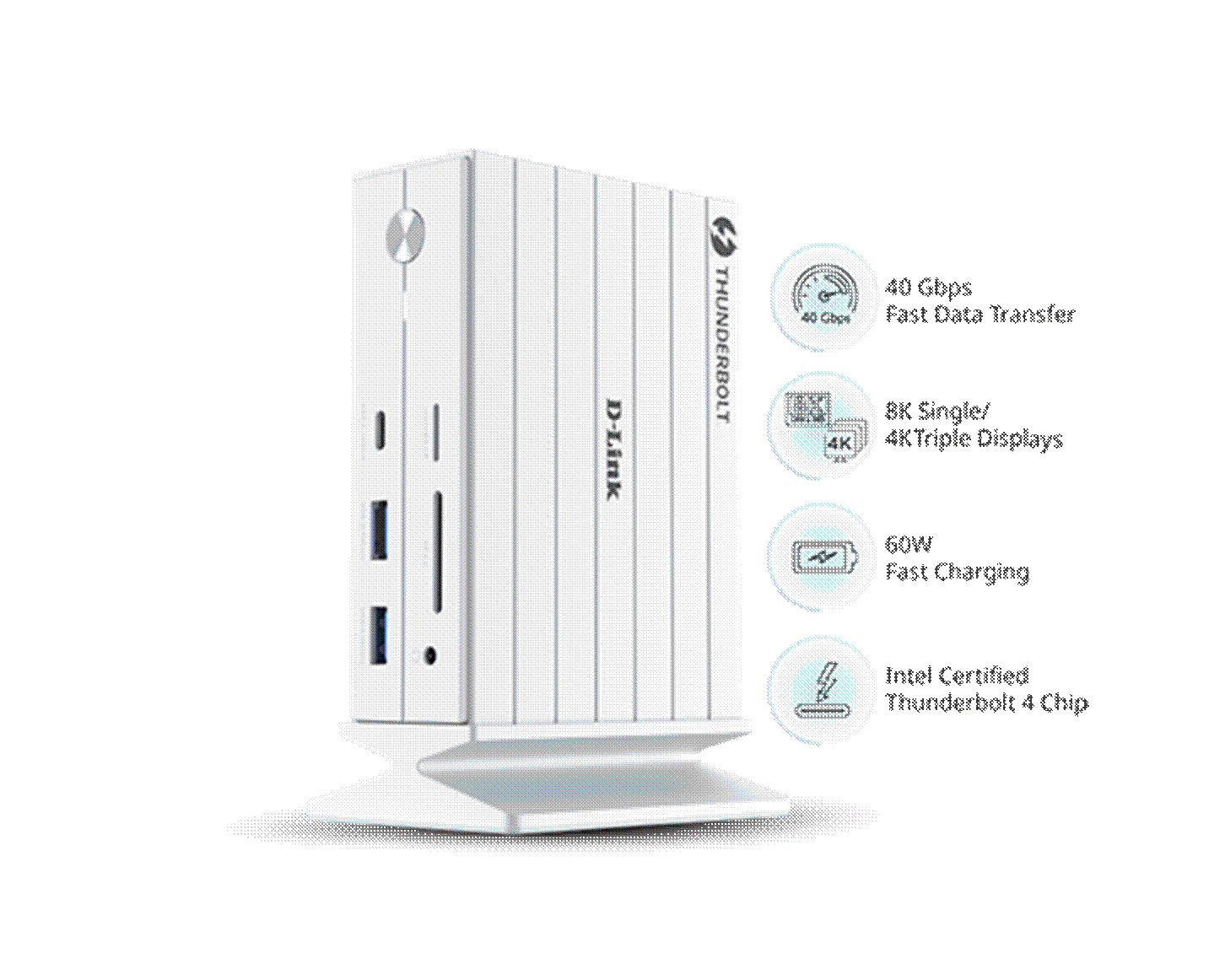
D-Link 14-in-1 Thunderbolt 4 Docking Station

D-Link Australia has announced the launch of the DUF-E01, a 14-in-1 Thunderbolt 4 Docking Station designed to transform any Thunderbolt 4-equipped laptop into a fully featured workstation. Combining ultra-fast data transfer, multi-display output, gigabit networking, and high-wattage laptop charging into a single aluminium device, the DUF-E01 is built for professionals, content creators and power users who need uncompromising performance at their desk.

Modern professionals increasingly rely on multiple displays, high-speed peripherals, and stable network connections to do their best work. Yet the move toward thinner, port-limited laptops has left many users juggling cables and adapters. The DUF-E01 solves this with a single Thunderbolt 4 connection that instantly expands a compatible laptop to 14 ports, with no drivers required on most modern operating systems.

“The DUF-E01 is designed for people who use their laptop as a primary computer and need it to punch well above its weight the moment it hits the desk,” said Graeme Reardon, Managing Director of D-Link Australia and New Zealand. “One cable in, and you have 14 ports, three screens, gigabit networking and your laptop is charging. That’s the kind of seamless experience professionals expect from a premium docking station.”

Key Features at a Glance

  • Ultra-Fast Thunderbolt 4 Connectivity: Up to 40Gbps data transfer via a single TB4 port.
  • Triple Display Support: Drive three screens simultaneously via HDMI 2.1 (4K), DisplayPort 1.4 (8K) and Thunderbolt 4.
  • Up to 60W Laptop Charging: Power Delivery through the TB4 port keeps your laptop charged while you work.
  • Gigabit Ethernet: Dedicated RJ-45 port for fast, stable wired network access.
  • SD and MicroSD Card Slots: SD 4.0 standard, supporting cards up to 2TB each.
  • Centralised Port Control: One power button switches all ports on or off simultaneously.
  • Integrated 3.5mm Combo Audio: Single jack for headphone output and microphone input.
  • Premium Aluminium Construction: Detachable magnetic base and aluminium alloy casing for superior heat management.

Thunderbolt 4: The Backbone of the DUF-E01

The DUF-E01 is built around a single Thunderbolt 4 upstream port that handles data, video, power and device communication simultaneously at up to 40Gbps. That bandwidth is four times faster than USB 3.2 Gen 2, giving professionals the headroom needed for NVMe drives, video capture cards and high-speed audio interfaces without bottlenecks under load. The TB4 port also supports daisy-chaining of additional Thunderbolt devices.

Triple Display Support: A Bigger Canvas for Your Work

The DUF-E01 drives up to three independent screens at once. DisplayPort 1.4 supports up to 8K at 30Hz or 4K at 120Hz, suited to high-resolution creative work. HDMI 2.1 delivers 4K at 60Hz for mainstream professional monitors, and the Thunderbolt 4 port adds a third video output. Users can configure any combination of extended or mirrored modes across all three displays.

60W Power Delivery: One Less Cable on Your Desk

The DUF-E01 delivers up to 60W of Power Delivery through the Thunderbolt 4 upstream port, covering most business ultrabooks and consumer laptops at full charge speed while in use. One cable provides displays, peripherals, network, audio and charging simultaneously, making docking and undocking as simple as connecting or removing a single cable.

Gigabit Ethernet: Wired Reliability in a Wireless World

The dedicated RJ-45 Gigabit Ethernet port delivers up to 1,000Mbps on compatible networks, offering the consistent latency and predictable bandwidth that Wi-Fi cannot always guarantee in busy offices or shared workspaces. For professionals on regular video calls or working with large files, a stable wired connection removes a common source of unpredictable performance.

Dual Card Slots: Instant Access for Creators

Both the full-size SD and microSD slots operate at SD 4.0 specification, with transfer speeds up to 985MB/s and support for cards up to 2TB. Photographers and videographers get direct, high-speed access to card media without a separate reader, handling high-bitrate video files and large RAW image sets quickly and conveniently.

Build Quality and Thermal Management

The aluminium alloy casing acts as a passive heatsink, drawing heat away from internal components during sustained workloads without requiring fans. The detachable base allows the dock to sit flat or stand vertically to suit any desk setup, and the premium construction is designed for years of daily professional use.

Compatibility and Requirements

The DUF-E01 requires a host device with a Thunderbolt 4 port. While the USB-C connector is physically compatible with many devices, full functionality including multi-display output, 40Gbps transfer speeds and Power Delivery requires Thunderbolt 4 certification. Compatible with macOS and Windows operating systems that support Thunderbolt 4.

Availability Thunderbolt 4 Docking Station

The DUF-E01 14-in-1 Thunderbolt 4 Docking Station with 8K Display Port and 4K HDMI port is available now from www.dlink.com.au and all authorised D-Link resellers and partners in Australia for AU$599.95 (RRP).

NetSuite Next AI Innovations to Help Businesses

Oracle NetSuite, the #1 AI Cloud ERP, today announced a series of AI-powered innovations to help organisations in Australia and New Zealand increase efficiency and accelerate growth. The updates will enable customers to take advantage of next-generation capabilities in NetSuite Next, automate and accelerate business processes, improve visibility and decision-making, and achieve faster outcomes.

“NetSuite is committed to delivering a collaborative, insightful, adaptive, AI-first experience that will help our customers in Australia and New Zealand take full advantage of the latest AI innovations,” said Brian Chess, senior vice president of AI, Product, and Technology, Oracle NetSuite. “With embedded AI that respects existing roles, permissions, and business policies, NetSuite helps organisations expand insights, boost productivity, and achieve immediate value from AI.”

A few examples of the latest innovations for customers in Australia and New Zealand include:

  • NetSuite Next: Helps organisations transform finance, operations, and customer engagement by embedding conversational intelligence, agentic workflows, and natural language search throughout NetSuite. With Ask Oracle, a natural language assistant that enables users to search, navigate, analyse, and act across the entire suite, NetSuite Next helps customers turn data into action, automate repetitive and complex tasks, and achieve outcomes faster, more intuitively, and with greater confidence. To learn more, please visit: NetSuite Next.
  • NetSuite AI Connector Service: Helps organisations select the AI assistant that best fits their business needs, define the data the assistant can access, and govern how the assistant interacts with NetSuite. Built on open standards, including the Model Context Protocol (MCP), the AI Connector Service provides a secure way to connect NetSuite with external AI assistants and agent platforms and includes Standard and Custom MCP tools.
  • Project profitability: Helps project-based organisations improve revenue recognition and task management by streamlining project oversight in NetSuite SuiteProjects. In addition, the latest enhancements accelerate issue investigation and resolution by enabling organisations to instantly recalculate revenue plans and providing real-time notifications when project activity impacts revenue.
  • AI-powered inventory narratives: Help organisations quickly understand inventory status with concise, contextual AI-generated summaries that pull data from multiple inventory reports. One of 20+ new AI-generated narrative capabilities across the suite, inventory narratives help organisations quickly surface anomalies such as low or excess stock, identify trends that require attention, and get clearer visibility into back-order risks, inventory activity drivers, and inventory valuation concentrations.
  • NetSuite Warehouse Management enhancements: Help organisations boost efficiency, improve visibility, increase flexibility, and enhance the user experience across warehouse operations. Organisations can search for kit and non-inventory items, automate landed cost validations and purchase order receipt processing, support reversal for inbound shipments, and receive real-time back-order alerts during work order picking.
  • NetSuite Connector for Loop: Helps organisations resolve returns faster and maintain cleaner financial data by automating the flow of returns data from Shopify into NetSuite. For example, organisations can manage refunds and exchanges with greater accuracy and control by automatically creating return authorisations, item receipts, and cash refunds based on Loop workflows and new self-service configuration tools.
  • Enhanced NetSuite Connector for Shopify: Helps organisations keep orders accurate across channels with bidirectional order edit synchronisation for Shopify B2B. As a result, organisations can ensure order changes in NetSuite — including pricing updates, quantity modifications, and line-item edits — are reflected accurately in B2B portals. This helps ensure that buyers see up-to-date information and helps operations teams reduce manual corrections and keep fulfilment, invoicing, and reporting aligned.
  • Enhanced NetSuite Connector for Amazon Seller Central: Helps organisations improve accounting accuracy and simplify reconciliation by automatically bringing payment and deposit data from Amazon directly into NetSuite. In addition, to help support auditability and revenue recognition alignment, the enhanced connector ensures full, partial, and split payments are mapped to the correct order or invoice.

Availability

NetSuite Next will be available to customers in Australia within the next 12 months. All other updates are now available.

Regular customers generate five times more revenue

Loyal regular customers are reshaping how small businesses grow in Australia’s suburbs, new data from Square’s 2026 Local Economy Report shows. 

With stubborn inflation and ongoing interest rate pressure weighing on household spending, most Australians expect their local spending to hold steady this year. In that environment, growth will not come from larger sales. It will come from customers returning more often and spending little and often.

This could be good news for local neighbourhood businesses, with Square’s data showing customers who return regularly generate five times more annual revenue than those who visit once and do not come back.

One-off customers often spend more in a single visit, in some cities nearly double the average transaction of a regular. But over the course of a year, repeat visits add up.

On average, a regular visits a business 12 times a year. It is that steady rhythm, not the one-off splurge, that is driving resilience in the suburbs.

The neighbourhood effect

Loyal customers don’t just support one business; they strengthen the entire neighbourhood. 

Square’s analysis shows local businesses increasingly share the same regular customers. Nearly three in four Australians now buy from a local retailer or restaurant within their postcode at least once a week. Most make multiple stops in a single neighbourhood trip. The café regular is often also the wine bar regular. The salon client is shopping at the boutique down the road. When one business builds loyalty, others nearby often benefit too.

“The suburbs operate differently to the CBD,” said David Schnabl, Head of Account Management at Square in Australia. “City centres depend on traffic while neighbourhoods depend on loyalty. When customers are spending most of their time and money close to home, one strong business can lift the others around it.”

That shift towards everyday local trade is something operators are actively planning for when opening new venues.

“When we look for a venue, we generally find the location first and then we tailor our brand to what’s needed in the area,” says Mike Ico, co-founder of Marrickville-based Superfreak, Soulmate & Splash. “We’re lucky because we live in the areas where we open our cafes. We think it’s better to open in a residential area because you get that everyday trade – and you also have that community from all the local neighbours.” 

Building loyalty over chasing bigger sales

With 68 percent of Australians expecting their local shopping and dining habits to remain steady this year, the opportunity lies in deepening relationships with existing customers, not waiting for a surge in new ones.

Square’s data shows tools that help businesses stay connected to regulars materially increase return custom. In 2025, 93 percent of Australian sellers using Square email marketing and loyalty features had regular customers, compared to just 39 percent of Square sellers without those tools. Sellers using marketing products such as loyalty or email saw on average four times more daily transactions and three times more daily spend.

This is reflected in consumer sentiment, with  more than a third saying a digital loyalty program would make them more likely to frequent a local business.

One business that’s been seeing the benefit of implementing a digital loyalty program is Suupaa, a Japanese convenience style restaurant in Melbourne’s Cremorne neighbourhood.

“People really value a loyalty system,” said Stefanie Breschi, co-founder of Suupaa. “When customers feel recognised and rewarded, they come back more often. We’ve seen first-hand how building those relationships turns occasional shoppers into regulars.”

Schnabl said the lesson for small businesses is clear.

“Right now, with businesses feeling the pressure, it’s tempting to chase the bigger sale. But the data shows it’s the regular who really matters: someone who pops in every week is far more valuable than someone who splurges once and doesn’t come back. The smart play in 2026 is simple: give people a reason to return.”

Neighbourhoods are settling into a new rhythm

In a tighter economy, Australians are being more deliberate about where they spend. And their local neighbourhoods are the main beneficiaries.

Spending close to home is becoming routine rather than reactive. Local cafés, retailers and service providers are part of weekly habits, not occasional indulgences. When one business earns a regular, it often strengthens the broader strip around it.

For small businesses, the direction is clear. The opportunity in 2026 isn’t to chase unpredictable foot traffic; it’s to become dependable, familiar and woven into the everyday lives of customers.

Schnabl said that should give operators confidence.

“Despite the economic pressure, Australians haven’t turned away from local businesses. They’re building habits around them,” he said. “If you focus on consistency, fair value and genuine connection, loyalty compounds. The suburbs aren’t slowing down: they’re finding their rhythm. And the businesses that become part of that rhythm will be the ones that thrive.”

You can view the full report here

Who gets the business – Parents leaving estate to charity

New Safewill research reveals more than 1 in 3 Aussie parents have considered leaving part or all of their estate to charity instead of their children, new research shows

With an estimated $5.4 trillion set to be transferred from Baby Boomers over the next two decades, new national research commissioned by leading online Will platform Safewill for Charity Wills Week reveals that more than 1 in 3 Australian parents have considered leaving part or all of their estate to charity instead of their children.

Interestingly, most shared they feel their kids act like it’s a given that they will receive an inheritance, many cited concerns that the money would be wasted by the younger generations, and others highlighted their belief that they should build their own wealth.

The shift echoes comments from Simon Cowell who has declared his legacy won’t go to his son, and will go towards charities giving others opportunities they might never have had, as well as high-profile Hollywood couple Ashton Kutcher and Mila Kunis, who have publicly stated they don’t plan to leave their kids large trusts, and instead plan to donate the majority of their wealth to charity, so it’s increasingly clear the sentiment toward the transfer of wealth is changing.

The research highlights a growing tension between expectation and reality, as younger Australians increasingly rely on inheritance to achieve financial security, while many Australians are reconsidering traditional legacy norms.

While only 8% of Australians have already included a charity in their current will, many more are contemplating it. Among Australians under 55, 40% say they plan to leave a charitable gift but haven’t yet updated their will to reflect that decision.

The generational divide is notable. More than half of Gen Z (51%) and Millennials (52%) either have or plan to include a charity in their will, alongside 40% of Gen X respondents, which drops off further for Baby Boomers and the Silent Generation.

Safewill’s own data shows the trend is accelerating, with the proportion of wills created through the platform that include a charitable gift growing from 5% in 2020 to 11% in 2025, more than doubling in just five years.

Despite this, more than half of Australians don’t have a current Will[1], so although they have strong feelings around how they would divide their assets, the reality of how their estate would be managed if they were to pass away would be entirely up to the state laws, regardless of private conversations or personal intentions.

Safewill Founder and CEO, Adam Lubofsky, says attitudes towards inheritance are becoming more values-driven, “for decades, it’s been assumed that children inherit automatically. What we’re now seeing is parents thinking more carefully about the kind of impact they want their estate to have, whether that’s supporting their children, backing a cause they care about, or a combination of the two.”

We expect to see an even sharper rise in charitable bequests in the wealth transfer over the next two decades, with our research indicating that emotion still plays a huge part in Australian legacy planning.”

Safewill’s Principal Solicitor, Isabelle Marcarian, says the rise in charitable giving reflects a broader shift in how Australians are thinking about legacy, but careful planning remains essential.

“What we’re increasingly seeing is Australians wanting their Will to reflect both their family and the causes they care about. Charitable gifts can be a powerful way to create lasting impact, and they tend to work best when families understand and support those decisions.

In Australia, spouses and children do have rights under family provision law, so if someone is considering reducing or excluding a family inheritance in favour of charity, it’s important to approach that carefully. Having open conversations and seeking appropriate advice helps ensure those wishes are ultimately honoured.”

In response to this, Safewill is offering all Australians the chance to write their Will for free until March 29, 2026, as part of the 5-year anniversary campaign, ‘Charity Wills Week’. This includes adding a charitable bequest, if this is something you would like to include in your Will. Visit www.safewill.com.au for more information.


[1] Safewill, “Free Wills Week” (unpublished raw data, 2025)

OpenAI accelerates startups credit program

OpenAI is expanding its startups credit program for Australian startups, offering eligible companies up to USD $50,000 (AUD $70,000) in API credits (up from a previous cap of USD $15,000 in credits) alongside 10 complimentary ChatGPT Business seats per company, including access to Codex, OpenAI’s agentic coding tool designed to support multi-agent development workflows.

The initiative was announced at the start of OpenAI Startups Week (16–20 March), which brings members of OpenAI’s global startups team to Australia for a series of workshops, builder lounges and technical sessions. The events are being hosted alongside venture capital firms and local AI companies, including Square Peg, Side Stage Ventures, Relevance AI, and innovation hub Stone & Chalk.

OpenAI first rolled out its Startups program in Australia last year, ahead of the official launch of its Sydney office in December. Since then, OpenAI’s local team has been working closely with Australian startups and venture capital firms, including companies such as Lorikeet AI and Relevance AI, to accelerate the adoption of OpenAI’s frontier models through API implementation, scaling AI-native products, and hands-on support for emerging builders.

The expanded program provides startups with early access to OpenAI’s latest capabilities across the platform, including multimodal models and Codex, the company’s agentic software development environment.

Thomas Jeng, OpenAI’s VC Partnerships Lead for APAC, said the program reflects the company’s growing engagement with Australia’s startup ecosystem.

“Since launching the program in Australia, we’ve already provided more than AUD $1.6M in API credits to local startups building with OpenAI’s technology. With companies like Canva and Heidi Health, Australia is home to one of the most dynamic startup ecosystems in the world. Having a local team on the ground means we can work directly with founders and developers to ensure they have access to the latest AI capabilities.”

“We’re excited to see how this expanded program helps Australian startups accelerate not only the products they’re building, but also how their teams develop new AI skills and workflows.”

The announcement comes as OpenAI’s Codex app gains rapid traction in Australia, with usage more than doubling in the month since launch. Designed as a command centre for agentic software development, Codex allows coding agents to operate in parallel across multiple projects, enabling teams to complete complex development tasks significantly faster.

The surge in adoption comes as OpenAI pushes to close Australia’s “AI capability gap” and unlock the nation’s potential as a productivity powerhouse. OpenAI-commissioned research suggests that if Australia fully harnesses AI, it could add $142 billion to the economy each year by 2030.

Internal data shows the top five per cent of Australian power users utilise around eight times more advanced reasoning and coding capability than the median user, underscoring the significant productivity gains available as more developers build advanced AI skills.

Kicking off at Adelaide’s Southstart Festival, OpenAI’s startups team will host a series of events throughout the week, giving founders hands-on exposure to the latest tools and capabilities across the OpenAI platform. Attendees will have the opportunity to participate in technical deep dives, live demonstrations and builder sessions focused on scaling AI-native companies.

OpenAI Startups credit schedule of events

[Adelaide – Southstart Festival]

  • 17th March: Thomas Jeng, OpenAI’s VC Partnerships Lead, APAC, to host afternoon builder session with Stone and Chalk (Time: 2.30pm to 5.30pm). Details HERE

[Sydney]

  • 18th March: OpenAI startups team and Relevance AI to host AI Builder Session at Relevance AI’s Sydney headquarters. Registrations HERE
  • 19th March: Thomas Jeng, OpenAI’s VC Partnerships Lead, APAC,will co-host a workshop with Square Peg for startup founders and builders on optimising multi-agent workflows and explore what’s new with Codex. 
  • 19th March:  Thomas Jeng, OpenAI’s VC Partnerships Lead, APAC to host an afternoon Builder Lounge event at Stone & Chalk’s Tech Central Innovation Hub. The event will explore multimodal updates, Codex, and where the platform is heading and include a technical deep dive and live Q&A. Details HERE
  • 20th March- Thomas Jeng, OpenAI’s VC Partnerships Lead, APAC to host a breakfast with founders in collaboration with key.ai. Details HERE

YOUR AI STRATEGY IS A REPUTATION RISK

Scrolling through LinkedIn used to feel like an insightful walk through a genuine business community; a place where leaders shared their personal experiences, debated original ideas and spoke genuinely about the challenges that shaped them into the successful leaders they are today. Today, there’s something off about the space. We are seeing a rise in what many are calling ‘AI slop,’ which experts identify as content that mimics thought leadership at first glance but delivers little value once you read past the headline. This quickly leads to reputation risk.

Spearheading two national brands has shown me just how powerful new technology can be. AI has already reshaped the way we work, plan and communicate. But as it becomes woven into our everyday routines, I’m noticing a shift: efficiency is edging out authenticity. And I get it. For us busy executives and professionals, it’s tempting to let an algorithm smooth out your voice. But the truth is, your reputation is built on how you show up, not how polished your sentences look.

The issue with AI-polished voices

The defining feature of AI slop is their similarities. I’m sure we have all seen the overused ‘Here are five lessons I’ve learnt this quarter’ hook, and the overpolished leadership reflections that could have been written by anyone, anywhere. Though it might succeed in satisfying the algorithm’s preference for consistency and greater reach, they would have already failed the human test.

Authenticity isn’t about perfection. It’s about clarity, intent and lived experience. When a leader shares something that feels generic or recycled, people notice. And in an era of infinite scrolls, trust is the only thing that doesn’t scale. The moment your network feels they’re reading a prompt instead of a person, you lose not only their attention, but also your seat as a trusted leader they can rely on.

Cost of looking smart but saying nothing

The risk here is not only low engagement but also credibility.

Leadership requires original thought, sound judgement and the ability to communicate with nuances. When a professional profile becomes a stream of automated insights, it signals a step back from genuine leadership. There’s also a clear contradiction in using AI to talk about ‘human‑centric leadership.’ If you cannot articulate your own perspective, why should your team or clients invest in it?

AI slop creates what I call a ‘value vacuum.’ It fills space without adding anything meaningful. Over time, this leads to platform fatigue. People tune out, not because they’re disinterested, but because they’re exhausted from reading the same thing dressed up in different words.

Using AI without losing your voice

This is not a plea to abandon AI, in fact, we should utilise it strategically. At Kwik Kopy and PACK & SEND, we’ve always embraced innovation, and AI has become an incredible ally. It helps us research efficiently, organise our ideas and get through the intimidating blank page.But it is also meant to support your thinking, not replace it.

What I’ve learned is that the balance matters.

  1. Let AI take the edge off the heavy lifting. This includes the tidying, summarising and grammar checks; however, keep the heart of the message uniquely yours.
  1. Be specific. Talk about real situations you’ve faced, the challenges that are unique to your industry or your community. Those are the details AI cannot reinvent, and they are what interest people.
  1. Be vulnerable. AI can attempt to imitate it, but it cannot feel it. The moments where things did not go according to plan and the lessons learned the hard way. When you share them in your own words, people recognise the honesty. That’s how trust is built and where connection happens.

Leaders who stay human stand out

As AI‑generated content becomes the norm, an authentic human voice will only become more valuable. While everyone’s feed is filled with automated noise, the person who speaks clearly and honestly, even if imperfect,  is the one people will hear.

Technology should help us move faster, but it shouldn’t flatten who we are. Our job as leaders is to steer the ship, not hand the wheel to an algorithm and hope no one notices we’ve stepped away. AI can amplify our thoughts and ideas, but it can’t replace the judgement, intent and authenticity that only humans can bring.

The leaders who understand and show up unapologetically as themselves are the ones people will keep choosing to follow.

Contributed by Sonia Shwabsky, President, Kwik Kopy Australia and PACK & SEND Australia.