About Angus Jones

Angus started his first small business in 1989 and has since gone on to have a successful career in marketing. He realised although there were many websites for small business none was addressing the question of how to. Angus has a passion to articulate benefits that add value to customers/readers.

App Cam Solo PRO 2K security cameras

Uniden has enhanced its outdoor security range with the new Super HD resolution App Cam Solo PRO 2K, offering a 100% wire-free, rechargeable, solar power compatible spotlight and security camera in one. Built for the outdoor environment, the compact device can be placed anywhere around the home for constant monitoring day and night, with additional smart features to make surveillance more accurate and responsive.  

The weatherproof App Cam Solo PRO 2K is designed for Australian homes and weather conditions, enabling users to capture and stream footage in high-quality 2K resolution across a 120-degree wide angle, making it possible to view and record with a wide image range in greater detail and zoom in to view objects easily. 

Adding a passive infrared sensor (PIR sensor) spotlight allows users to better see the appearance of anyone approaching the property while also acting as an effective deterrent to unwanted visitors. Combined with a built-in spotlight, adds colour to the night vision footage up to 10 metres away to ensure a high-quality image.

Smarter than regular cameras, the Uniden App Cam Solo PRO 2K features Ai Intelligent Alerts for the ability to notify the user via the SOLO App whether there is a person or vehicle approaching the property, meaning you will only get alerted when you need to be. Together with the Thermo Sense Technology body heat and movement sensor, this feature reduces the number of false alerts a security camera may trigger due to moving branches and other benign activity, ensuring residents are only notified when needed.

To minimise reliance on electricity supply and regular recharging, an optional Uniden Solar Panel can be used alongside the camera, positioned for optimal sunlight exposure, delivering up to 180 days of operating time. The solar panel recharges the App Cam while providing non-stop power during daylight hours, allowing footage to be recorded and viewed without the risk of draining the battery. It even alerts the user on battery level to prepare for charging.

Users can easily track App Cam Solo PRO 2K vision from any smartphone device for remote live viewing in 2K quality using the Uniden SOLO app globally. It also facilitates two-way communication or voice alerts that can help deliver goods to the front door. Privacy masking can black out the areas a user does not want to be recorded and prioritise where surveillance needs to be on.

Delivering optimal peace of mind with its dual backup system, the App Cam Solo PRO 2K offers the choice of storage via a purchased SD card or via the Uniden Cloud service, which offers rolling seven days of free cloud backup for the lifetime of this product. For those with higher storage requirements, upgrading to a suitable paid plan is easy.

Thanks to the wire-free over WiFi capability, both homeowners and renters can choose one or more of these cameras to monitor more of their home, from the front door to the garage, in one easy DIY-installed solution without the need for ongoing fees or subscription costs.

App Cam Solo PRO 2K Key features:

  • 2K super HD resolution
  • Completely 100% wire-free over WiFi
  • Spotlight & Camera in One
  • AI intelligent alerts and notifications
  • Colour Night Vision
  • Two-way talk
  • Free 7 Days of Rolling Cloud Backup + Micro SD Card Backup 
  • Privacy Masking 
  • Thermo Sense Technology
  • Compatible with Google Assistant and Alexa
  • Dual Band WiFi (2.4GHz/5.8GHz)
  • Rechargeable battery
  • Optional Solar Panel for non-stop power with up to 180 days of operating
  • Siren alert 
  • Motion detection record 
  • Weatherproof (IP65) 
  • Two-year Australian warranty 

Uniden Guardian App Cam Solo PRO 2K RRP: $279.95

Uniden App Cam Solo+ Solar Panel (SPS-02) RRP $99.95

Retailers prepared for economic challenges

New research from leading parcel delivery company CouriersPlease (CP) has revealed that nearly 9 in 10 retailers (86 per cent) are prepared for continued inflation, higher interest rates and potentially lower consumer spending. They have revealed the changes they have made in the last two years to help them buffer any impacts.

The research was derived from a survey of an independent panel of 202 owners and decision-makers across Australian retailers, commissioned by CP. Three-quarters (77 per cent) of respondents were owners or decision makers of SME retailers (with up to 200 employees). The full survey results, including breakdowns across States and business sizes, can be found here: couriersplease.com.au/portals/0/inflation-impact-on-retailers-white-paper.pdf

Nine in 10 (89 per cent) respondents rated their business success as good or excellent so far this year, indicating they are in the best position they can be to buffer negative economic impacts.

CP presented respondents with a list of eight actions that a business is likely to have made in the last two years to weather a tougher economic environment. The majority (86 per cent) selected at least one change, indicating they are prepared for inflation and high interest rates. Specifically, 36 per cent revealed they had boosted their investment in eCommerce and marketing and 35 per cent gave their workforce flexibility. Nearly a third (32 per cent) expanded their product range.

Other changes retailers made were reviewing suppliers and switching or renegotiating supplier contracts (chosen by 29 per cent of respondents); introducing more efficient technologies (chosen by 23 per cent); improving customer service (23 per cent); tapping into new customer segments or markets (21 per cent); and transitioning sales online or closing bricks and mortar stores (19 per cent).

Just 4 per cent of respondents revealed their business had been too negatively impacted to make changes.

CP asked retailers what negative impacts their businesses are likely to counter this year. More than half (53 per cent) of the retailers surveyed said they expected their profits to be squeezed, while 50 per cent said they will experience lower revenue due to lower consumer spending, and 41 per cent will struggle to keep prices reasonable for their customers.

CP CEO Richard Thame says: “The results confirm the widespread impact the current environment is having on the business sector. It appears that the economic climate will have the most impact on a company’s bottom line, with profits and revenue expected to take a large hit. With the CPI currently at 5.1 per cent, and an increase on the horizon, as well as interest rates continuing to climb, retail and logistics businesses will look for efficiencies across operations and other business areas to buffer these impacts.”

Other impacts retailers identified included postponing investment into the business (chosen by 28 per cent of respondents), being unable to keep all their employees (chosen by 21 per cent), and facing challenges meeting loan and rent payments (19 per cent).

Just 10 per cent of retailers revealed their business would not be impacted at all. This very small proportion immune from the impact of the current environment was also similar across business sizes: just 8 per cent of micro businesses and 13 per cent of small to medium-sized businesses said they wouldn’t be impacted by inflation and rate rises.

Respondents were also asked to share the most important lessons they learnt over the last two years. The top responses included being more flexible and adaptable to change, including a resilience and preparedness for the unknown; focussing on customer service and loyalty to continue driving sales; and the importance of investing in an online presence. Other respondents had an unfavourable perspective on Government support and stimulus during this time and revealed their biggest learning was that they can’t always rely on such assistance during tough times.

Richard adds: “It is promising to see that a significant proportion of retailers have already made changes that will protect their businesses over the medium term. Retailers understand this year they will compete in a climate of reduced spending, and an online presence and a strong customer experience will help them maintain and grow their market share. Parcel deliveries are the only physical contact that pure e-tailers have with customers, raising the importance of the courier-retailer partnership in delivering a positive customer experience. Onboarding a courier partner with a proven record of fast, safe and flexible delivery options will become an increasingly important component in sales and customer loyalty strategies.”

Can a Chromebook be used for business?

Setting up or even maintaining computers in a business can be a very expensive and complicated process. So is there a better way? Can a Chromebook be used for business? This guide will look at why you might consider a Chromebook, what you need to understand, and how you decide which one to buy.

A Chromebook refers to a laptop or 2in1 that runs Google’s Chrome Operating system. The experience is a pure web browser interface and will not run windows applications.

WHY should you consider a Chromebook over a PC for business?

We live in a connected world. If you visit Officeworks, it isn’t easy to buy a piece of standalone software that you load onto a computer. Everything is now cloud-based solutions, and you use your browser to access your application via the internet. A business will most likely use an accounting package like Xero, a CRM database, a POS system or even a spreadsheet, all accessed via the internet.

Why would you not use a Chromebook?

Suppose your business needs a standalone software application with many dedicated computer resources (e.g. memory, fast processor etc.). In that case, a chrome book is not for you.
If you need to work mostly independent of the internet or there is simply no internet, then a chrome book is not for you.

Why should you consider a Chromebook?
  • Prices of Chromebooks are considerably cheaper than a PC, and this is because the hardware requirements are significantly lower.
  • A Chromebook’s reliability is likely higher as it is a simpler Operating system with no extra software that is loaded, whether for applications or hardware drivers. Thus everything is simpler, and it is unlikely you will need the services of an IT Guy.
  • Light and compact. A Chromebook is likely to be far less power-hungry so that batteries can be smaller and last all day. Thus delivering you a small package, especially if you are on the road.
  • Instant On. A Chromebook does not need to load lots of code to start and will open at the press of a button, ready for you to access information.
  • Cloud-based storage means you never run out of capacity, and the information is backed up automatically.
  • Android Apps designed to run on smartphones and tablets will run on a Chromebook

WHAT should I know about Chromebooks?

The Chromebook itself does not need to be very powerful. Almost everything you do is done online or, more correctly, in the cloud. Thus although the hardware is not as powerful, the user will not experience any disadvantage over a much more powerful PC. However, one caveat is that if your internet connection is not reliable, this will affect performance.

A Chromebook was designed with security in mind and will be safer than a Windows or macOS computer. Security updates happen automatically, and no viruses or malware are known to target Chromebooks. Indeed, you do not have to buy antivirus software.

Unlike a PC, a Chromebook comes standard with productivity software for word processing, spreadsheet, email, presentations etc. The Google productivity suite is the core software; however, Microsoft applications can be installed just like downloading an app on your smartphone.

You will never lose your work because everything is in the cloud and saved when you type it. Thus, assuming you have an internet connection, you will never regret ever not saving a document or forgetting to back up your computer.

If you are without the internet, you can still use your Chromebook to read email, take notes, create and edit documents, spreadsheets and slides, view and edit photos, listen to music, watch downloaded videos and play games offline.

Collaboration is key for sharing information with your workmates, so everyone is updated. As everything is stored in the cloud, sharing the latest information is a simple one-off permission click to allow others to share real-time data.

No extra software is needed, but if you need something, additional Android apps can be installed.

A Chromebook will connect to printers, keyboards, a wireless mouse and most importantly, an external monitor to give you the flexibility to work off a large screen.

HOW do you decide which Chromebook to buy?

Unlike our guide on which PC I should buy, your choice is determined by how you will use the Chromebook. A basic Chromebook can be purchased for a few hundred dollars, and more expensive models can have touchscreens and be used as a tablet, giving more flexibility on the road.

Options you will consider when choosing a Chromebook:

Screen size will determine the size of the unit, which may be important if you require to take the Chromebook on the road. Sizes vary from 10 to 15 inches.

A chrome book can come in the following form: laptop, convertible or detachable tablet. We like the fact you can use it as a tablet. To support this, the screen may be detachable from the keyboard, or the keyboard may swing behind on 360-degree hinges.

A touchscreen improves your ability to interact quickly with your Chromebook, especially when it is hard to use a keyboard. A stylus may also be useful, especially if you want to make handwritten notes or draw.

Consider the battery life, and will it last you the time you expect to be away from mains?

Colour is the case, not the screen, if fashion is important to you. A protective cover is also a good idea and may help position the unit.

Ram will be in the 4 to 8GB range. With 4GB is adequate for most users.

All Chromebooks use solid-state storage rather than spinning hard drives. As storage is online, you would only consider a larger capacity if you want offline access.

Some Chromebooks now have expanded keyboards with a number pad to the right of the letter keys for those working with lots of numbers.

Processor variants are available but are not as important as a PC specification as all the tough computing work will be done in the cloud.

Connectivity is a consideration if you require an onboard 4G/5G connection and also if you need Wi-Fi 6 over Wi-Fi 5.

Other options to consider include the quality of the camera, availability of extra USB ports and support for wireless charging.

The following brands sell Chromebooks in Australia:  Acer, Asus, HP, and Lenovo.

HINTS

Suppose you still need to run a standalone PC program. In that case, you can use Google’s Chrome Remote Desktop app on your Chromebook to access traditional desktop software via another computer. This app allows you to access a running PC from any location and emulate the screen on your Chromebook.

To research this topic, Small Business Answers trialled an ASUS CM3000DV Chromebook. Our findings were quite the opposite of what we expected. We thought a Chromebook would not suit business, but we completely changed our minds. The Chromebook could handle everything I had done on a 13-inch i5 Intel notebook. TheCM3000 has a detachable cover that acts as an adjustable stand in either horizontal or vertical orientations. The detachable keyboard allows 1.5mm of movement on each key, giving a realistic typing experience while keeping the package compact. Two features I loved were the included stylus and a 15-second charge providing 45minutes of use. (yes, you did read that correctly)
The CM3 is 8mm thick with a 10-inch display and up to 12 hours of use. It is a touch screen device and weighs only 0.51kg. A front 2M camera, rear 8M camera, microphone, and stereo speakers enhance multimedia capability. It only has 1 x USB-C socket so you may need a USB hub, but it supports Wi-Fi 5 and Bluetooth connectivity. For those familiar with the Google ecosystem, it helps Google Assistant and comes with one year of 100GB of Google cloud storage. Our test unit had 4GB of RAM, a 2Ghz processor and a 64GB SSD drive but we would have had no idea about this as the Chromebook just worked.

SUMMARY – Can a Chromebook be used for business?

Can a Chromebook be used for business? Yes!

When deciding to use a Chromebook, you must ask, is chrome OS the right choice for you? It will change your current mindset but remember the kids are doing it fine at school as their first computer, and they don’t know any better.

A Chromebook is a browser and app-based device that uses the internet and the cloud to do all the work. Almost every type of application today is on the cloud, so an expensive notebook computer may indeed be overkill versus a Chromebook.

A Chromebook can still be bought in different configurations, and carefully consider which options best suit your needs.


Keep COVID and flu safe

Keeping workplaces COVID and flu safe ensures teams, businesses and industries can continue to move forward. Helping limit the transmission of viruses in the workplace and illness among staff is a key part of this.

There are five key things businesses can do to help reduce the risk this winter:

  1. Encourage staff to ensure their COVID-19 and flu vaccinations are up to date, including a booster. Those aged 30 years and over who had their COVID-19 booster more than three months ago are now eligible for an additional winter booster. It is strongly recommended for those aged 50 years or over. With the number of cases expected to rise in the coming weeks, there is no time to wait.
  2. Ensure staff stay home if they are sick, even with mild symptoms, and get tested as soon as possible. If they test positive for COVID-19, ensure they remember to inform employers and register their rapid antigen test results with Service NSW to receive the right health information.
  3. Have a risk assessment plan in place for positive cases, household, and close contacts. While household contacts do not have to self-isolate, they are still at risk of unknowingly having and transmitting COVID-19. Safe Work Australia has the latest information and checklists to help businesses with return to office plans for both positive cases and close and household contacts.
  4. Remind staff it is mandatory to wear a mask when commuting on public transport, taxis and rideshares and in high-risk settings. Masks are strongly recommended in all indoor public areas.
  5. Create well-ventilated meeting spaces where possible. Ensure there are well-ventilated, large spaces for meetings or encourage virtual, walking or outdoor meetings, which can help reduce the risk.

The NSW Government has developed a toolkit to help businesses communicate to staff, customers and visitors so everyone knows how they can help keep workplaces COVID-19 and flu safe.

Small Business Index reach record high

Faster payment times and stronger jobs growth help the Xero Small Business Index reach record high

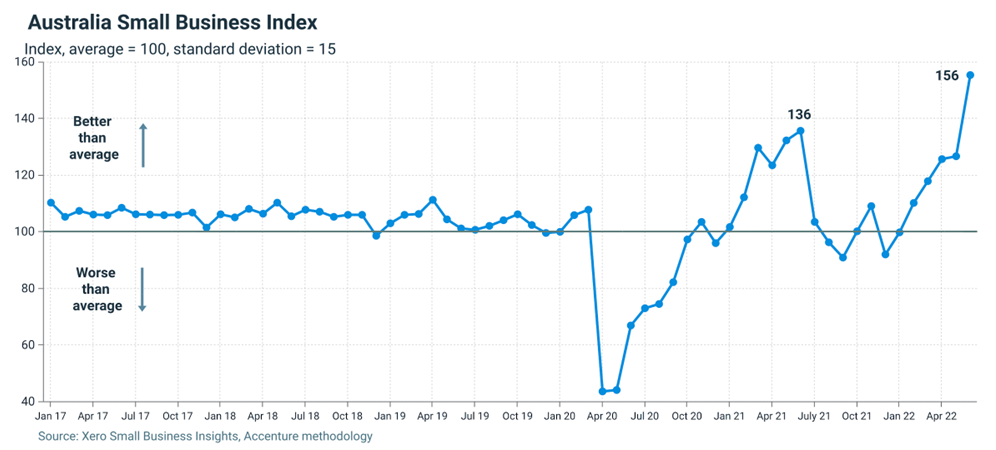
Australian Index rose to 156 points in June, as payment times decline due to EOFY

Xero, the global small business platform, today released its latest data on the health of Australia’s small business economy during June from the Xero Small Business Index. Based on aggregated and anonymised transactions from hundreds of thousands of small businesses, the Index, developed in collaboration with Accenture, is part of the Xero Small Business Insights program.

Xero’s Small Business Index for Australia rose 29 points to 156 points, the highest result ever recorded. The increase is largely due to a decline in the average time small businesses waited to be paid, which fell 3.5 days to 20.1 days. The big fall is likely off the back of the end of the financial year, and echoes a similar shift that New Zealand and the United Kingdom saw in March. For the other metrics, wages and sales recorded a slowdown and jobs delivered the best result since November 2021.

Joseph Lyons, Managing Director Australia and Asia, Xero, said: “The time it takes for small businesses to get paid can massively impact cash flow, so it’s encouraging to see a drop in payment times. Although this is a seasonal impact, there is still reason to be cautiously optimistic – after all, healthier cash flow equals stronger small business performance. Despite inflation impacting Australian household spending, sales growth has continued at a double-digit pace.”

Sales holding up better in Australia than in New Zealand and the United Kingdom

Despite customers facing cost of living pressures, sales have held up, rising a healthy 10.6 percent year-on-year (y/y). All industries recorded positive sales growth, led by administrative services at +15.9 percent y/y. This is a nominal measure of sales and includes both price and volume impacts. When prices are taken into account, using the June quarter Consumer Price Index, the volume of sales rose a smaller 4.5 percent y/y. But this shows that small businesses still sold more goods and services in June 2022, compared to the same period in 2021.

This is a much better result than the experience of small businesses in the United Kingdom and New Zealand, where sales actually declined in the year to June once the impact of price rises were removed.

“The sales results show that Australian small businesses are continuing to sell more goods and services than they did a year ago, despite customers facing cost of living pressures,”said Louise Southall, Economist, Xero. “It’s a testament to how our small business economy has continued to show resilience through the current inflation crisis.”

Strongest jobs result in 2022

June recorded the strongest jobs result for 2022, increasing 2.0 percent y/y, following a 0.2 percent y/y rise in May. Leading these results were administrative services (+6.9% y/y) and professional services (+4.4% y/y), echoing previous months where industries that facilitate working from home have been better able to grow jobs. Continuing recent trends, education and training (-1.9% y/y), wholesale trade (-0.5% y/y) and agriculture (-0.2% y/y) were the three industries still recording declining jobs.

“The jobs result is hugely positive, and fantastic to see a rebuilding in recent months after a soft start to 2022,” said Southall. 


The end of financial year improves time to be paid


The average time small businesses waited to be paid fell by 3.5 days in June to 20.1 days. There  was also a 2.2 day decline in late payments to 4.7 days – which is a record low for this series which began in January 2017. These improvements, while welcome, are most likely due to the end of the financial year and could be revised up in future months. For example, in June 2021 the initial report was for a 2.9 day decline to 20.1 days but this reading has since been revised up to be 22.4 days.

To download the full June results, including industry and regional breakdowns, go to the website here. To find out more about how the Xero Small Business Index is constructed, see the methodology.

TIPS FOR BUSINESS

CHARTERED ACCOUNTANT TIPS FOR BUSINESS AS ECONOMIC WARNING BELLS SOUND

With the Treasurer sounding alarm bells, business owners are once again reviewing their business plans and balance sheets whilst still managing hits from the pandemic and rampant inflation.

Chartered Accountants are helping businesses navigate this challenging economic period and prepare for what is likely to be a prolonged period of tough economic headwinds.

“It’s an incredibly difficult time for business owners, and given the state of the economy described today, it’s unlikely there’s any new direct assistance on the way from government,” said Simon Grant, Group Executive Advocacy, Professional Standing and International Development at Chartered Accountants Australia and New Zealand.

“That’s why Chartered Accountants are working closely with their clients across the country to support them in getting in the best possible shape to meet what are going to be extended tough operating conditions.”

Chartered Accountants offered the following tips for business to help clients deal with difficult fiscal conditions:

Get the information you need to take a risk: One of the biggest barriers to growing a business is uncertainty – and it’s important not to be trapped in the headlights of negative sentiment. Businesses should work with well-informed decision-makers who can help them take action – and understand that they will continue to need to take risks, with the right advice, to keep moving towards their goals.

Look for efficiencies: Tough economic times demand that businesses take a good long look at how they do things to see if there are productivity savings to be achieved. Experts estimate that about 75% of possible productivity gains can be achieved by simply adopting existing best practice processes.

Reduce expenses: With so many businesses failing because of cash flow problems, there are some simple ways to cut down costs. Hold virtual meetings to save time and travel costs; use free or cost-effective digital payment services; look for alternatives to paid advertising, such as social media; go paperless; get rid of landline phones and faxes; look to make savings on insurance; improve time management and consider whether you need office space with the rise of virtual workplaces, or virtual and flexible workforce solutions while talent shortages continue.

Make the most of what you’ve got: Encourage clients to make sure their business is making the most of the resources it already has – including investing in employees and maintaining a sharp customer focus. Clients should also audit their business assets and ensure they are extracting maximum value from their investments – this is not the time to leave anything in the tank.

Grow your market: Look for opportunities to grow your market share and innovate, particularly as cash-strapped rivals hit the wall. There will be gaps in the market as times get tougher and tougher, and you must be alert and ready to move in to fill any voids which emerge.

Whiteboard for RingCentral Rooms

 RingCentral, Inc. a leading provider of global enterprise cloud communications, video meetings, collaboration, and contact centre solutions, announced an expansion of its hardware ecosystem and new feature enhancements for RingCentral Rooms™. With return to office becoming a focus for many organisations, 76% of respondents in a recent US survey1 reported that technological improvements and upgrades to conference rooms is a key priority.

RingCentral Rooms enables organisations to transform their meeting spaces into dynamically enabled video conferencing destinations. It extends RingCentral Video and allows customers to have the same great video experience in a conference room that they already have in a home office or on the go. Now customers can select among several new hardware partners to enhance their conference rooms with high-quality, intelligent audio and video, and whiteboard – allowing room participants to better collaborate and be better seen and heard.

“RingCentral Video has been great for maintaining that sense of team, especially during the lockdowns when we were all remote. And now that some of us are coming back into the office, having RingCentral Rooms is also great to make everyone’s conference room experience consistent and ensure we can always include anyone, anywhere, in our meeting,” said Justin Collins, IT manager at Credit Human Federal Credit Union.

New RingCentral Rooms Hardware Partners 

As old conference rooms undergo improvement, IT decision makers are turning to technology providers for the most advanced rooms solutions that allow workers to collaborate efficiently. To meet these needs, RingCentral is partnering with three added hardware vendors.

Avocor: RingCentral is partnering with Avocor, a leading global provider of touch-enabled interactive displays, to unveil new innovations for RingCentral Rooms. Through this partnership, the company is bringing RingCentral Rooms For Touch™ to market, which allows customers to join and end meetings with the touch of a finger. Customers can harness new capabilities through a new series of Avocor Collab Touch hardware displays with RingCentral Rooms for Touch software, including digital whiteboarding and on-screen annotation. RingCentral Rooms for Touch will be compatible with Whiteboard, a virtual collaborative canvas now available to customers in beta.

EPOS: A premium audio brand, EPOS, recently announced a new line of meeting room solutions using EPOS BrainAdapt™, a group of technologies that are designed to support the brain’s natural way of processing sound. It enables users to easily adapt to a hybrid meeting sound environment and reduce cognitive load through a video bar device. With support for RingCentral Rooms on EPOS Expand Vision 5, customers can leverage the premium audio of EPOS and the latest collaboration features for meeting rooms to deliver a great experience for customers. (RingCentral Rooms software is scheduled to be certified with EPOS Expand Vision 5 video bar by Q4.)

Jabra: By partnering with a leader in personal sound and office solutions, RingCentral Rooms is able to harness Jabra’s advanced onboard AI to deliver an intelligent feature set that takes users’ video experience to the next level. Jabra’s PanaCast 50 intelligent video bar is certified for RingCentral Rooms. PanaCast 50 can automatically detect who’s speaking and intelligently adjust the picture to focus on them, delivering a better meeting experience that puts the most important content front and centre.

“Strong relationships with strategic hardware partners are important as we strive to address the complex challenges around fostering collaboration in modern hybrid work environments. We are excited to work with innovative partners like Avocor, EPOS and Jabra,” said Kira Makagon, chief innovation officer at RingCentral. “When paired with our partners’ advanced hardware offerings, RingCentral Rooms can unlock the full potential of today’s hybrid workforce and enable equitable collaboration for workers wherever they are.”

In addition to these new partners, RingCentral continues to innovate through long-standing Rooms partnerships with hardware solution providers Logitech, Poly and Yealink, giving users a wide range of RingCentral Rooms-enabled, all-in-one video conferencing solutions.

A Plethora of Rich and Intuitive RingCentral Rooms Features

In addition to partnerships, RingCentral has also announced key new feature enhancements for RingCentral Rooms that will enable interactive experiences for customers in hybrid work environments. These features include:

●      Whiteboard for RingCentral Rooms: Whiteboard for RingCentral Rooms allows users to co-create and collaborate with other participants regardless of whether they are in a room or home office. It’s easy to annotate and organise ideas with digital sticky notes and shapes using the whiteboard’s immersive, near-infinite canvas.

●      Proximity sharing mobile: Sharing content from a user’s mobile device amongst meeting participants in a room is now made possible with the new proximity sharing mobile feature.

●      Share and View room camera full screen: Just like screen sharing, this feature further elevates the collaboration experience by sharing the meeting room camera full screen to enable remote participants to get closer views of what’s happening in a room.

●      E2EE Rooms support: RingCentral Rooms supports end-to-end encryption, which means data is encrypted for its entire journey between endpoints, and no one other than meeting participants has access to that information.

●      Closed Captioning: With closed captioning, users can enable on-screen captions. This gives better engagement for those who need extra language assistance, are hearing impaired, or simply want to be able to follow along and read what’s being said in the room’s environment.

●      HDMI share: With the new HDMI share, it’s easy to share presentations or content from a user’s laptop into the meeting room. Simply plug the RingCentral Rooms HDMI into any laptop to instantly share screens with all meeting participants.

●      Rooms activation code: Instead of using admin credentials to register each new conference room with a Rooms licence, it’s just a matter of hitting a few buttons. Admins can provide an activation code for each room and turn on Rooms remotely, easing the burden on IT.

“As businesses adapt to the hybrid work model, one thing is clear – investments in office meeting spaces will continue to grow,” said Roopam Jain, VP of Research at Frost & Sullivan’s Connected Work Practice. “RingCentral’s new features, including Whiteboard, are designed to enhance team creativity and inclusivity with the goal of narrowing the effectiveness gaps found in most hybrid collaboration environments and better connect today’s dispersed workforce.”

For more information about RingCentral’s hardware partners and its Rooms-enabled solutions, visit .

MobileMuster recognises e-waste products

MobileMuster, the telecommunications industry’s flagship product stewardship program, has announced hardware manufacturer TP-Link as the latest business to join the expanding program, which collects and recycles a broad range of end-of-life telecommunications e-waste products.

The new membership will see TP-Link, a global provider of reliable networking devices and accessories, including wireless routers and adapters, join existing MobileMuster members who are playing an active role in addressing the growing electronic waste issue.

Run by the Australian Mobile Telecommunications Association (AMTA), MobileMuster in July announced the expansion of its product stewardship scheme beyond mobile phones to now include three new, growing e-waste product streams, including network connectivity, smart home technology, and wearables and peripherals.

Spyro Kalos, Head of MobileMuster, said with Australia currently ranked fifth in the world for the generation of electronic waste per capita, the program’s expansion to enable more unwanted devices to be recycled correctly was essential.

“Expanding the scope of products collected and recycled through MobileMuster will further demonstrate how the industry can work together to deliver measurable social and environmental outcomes that benefit the local economy and consumers.

“MobileMuster’s aim is to play a genuine role in creating a more sustainable circular economy through product stewardship. We are delighted to have TP-Link join our other members in demonstrating leadership and action through their commitment to a more sustainable future.

Neville Wang, Managing Director of TP-Link, said, “As our connected lifestyles continue to evolve and consumers seek new and improved devices, TP-Link continues to expand our product offering to anticipate and meet the demands of tomorrow.

“At the same time, we are very conscious of the growing e-waste issue globally and recognise we have a crucial role to play in minimising the impact of those devices on the environment over the long term.

“TP-Link’s business values align well with the sustainable e-waste solution that MobileMuster provides. We encourage more businesses to follow suit and join the program to keep more electronic devices out of landfill.”

MobileMuster is the only voluntary government-accredited electronic product stewardship scheme in Australia and provides a complete e-waste solution to address the environmental, health and safety impacts of telecommunication products across their full life cycle. The program is funded by members, including the major handset manufacturers and network carriers alongside a growing number of other electronic hardware manufacturers.


We can Manufacture in Australia – ooGee

Small Business Answers recently sat down to talk to headgear veteran Peter Walcott who is breathing new life into manufacturing in Australia. In this interview, we delve into Peters 40 year journey to decide to manufacture in Australia rather than importing for his new range of ooGee brand of hats.

ooGee comes from an aboriginal word for headdress.

Peter Walcott’s background?

Forty-three years ago, Peter was working in a Bottle shop when a friend of his dads was looking for someone to help in his hat business packing hats. Peter soon found he had a knack for sales, which led to a flair for ideas and design. He went on to run, then own that business that imported hats and haberdashery.

Covid arrived, and like so many, Peter started reassessing what would be next. He decided he wanted to give local manufacturing a go.

What was the problem/opportunity that drove a change?

Peter thought a new Australian-made hat would be “Fun to do and good to see”. This translates to his desire to reinvigorate local manufacturing and ensure the future of traditional hat-making in Australia.

Peter saw an opportunity to create a stylish hat that suited Australian conditions. One that would always be stylish can survive going for a swim, is cool to wear and can be packed in a bag.

The next stage was to develop something new that was not straw or felt that are easily damaged and hot to wear. His experimental journey took him to the concept of making a hat out of braid. Many prototypes and manufacturing experiments later, the ooGee hat was born with innovations. Such as Flexibraid, meaning the hat bounces back into shape and facilitates airflow, and Comfy-Fit ensures the perfect fit the hat does not blow off your head from a gust of wind.

Why manufacture locally? Can you compete?

Peter was seeing a backlash against products made in China. In addition, if he manufactured in China, he would have to commit to large order quantities. The hat being a fashion item meant that a style may be attractive to the designers but not the general public. Local manufacturing means Peter and his team can trial a new design with a short production run. Depending on how sales go, decide whether they will make any more.

Peter estimates he is paying a 20% premium in costs. Beyond flexibility to test the market, his product is Australian-made. It uses higher quality materials, including Australian cotton, recycled materials, and real leather on some models. This more than justifies the small price difference.

What challenges has OoGee faced?

Once Peter was ready to manufacture, his biggest challenge was finding locally skilled labour expertise. Covid played into his hands with a uniform company having to let staff go. Peter found a key person that led to others, ensuring he had the right team to produce his product.

His next challenge was distribution and finding retailers to sell his product. He was surprised that having a quality Australian-made product was selling itself. His Ogee brand can already be found in retailers and resorts all over the country.

Advice for Small Businesses wanting to manufacture in Australia

Peter’s advice is to be different from others, which will drive better margins. Peter says, “Do your sums! No margin means no profits, which means no business!”

Peter’s other advice is, “If you have the ideas, don’t partner in the ownership of the business. It leads to conflict, especially with friends.” However, Peter partners with other businesses to help drive his various brands, which have been very successful.

Length of business trips increases

Have you missed travelling? It seems many have to the point that the length of business trips are longer. New data from leading travel management company Corporate Traveller has revealed that business travellers have more than doubled the length of their trips this year compared with 2019, with the most significant extension being international trips, followed by domestic, then Trans-Tasman.

Corporate Traveller, Flight Centre Travel Group’s flagship travel management provider for SMEs, sourced the findings from its travel booking data from January to May 2022, comparing it to bookings in the year before the pandemic – specifically, January to May 2019.

So far this year, the average domestic business trip has been 3.09 days long, compared with just 1.1 days in 2019, while Trans-Tasman trips have averaged 2.6 days this year, compared with 1.3 in 2019. The lengths of international trips overall have been averaging 8.7 days this year, compared with 3.4 days in 2019.

Tom Walley, Global Managing Director at Corporate Traveller, says there are many reasons behind extended trips this year.

“With most restrictions removed, more businesses are meeting with interstate and international stakeholders face-to-face. After two years of virtual meetings, face-to-face meetings are likely increasing in frequency,” Mr Walley said.

“Executives may also be reuniting with teams for the first time since 2019 and engaging in lengthy operational and strategy meetings in person. Some businesses are also rebuilding again to focus on their growth and conducting longer sales and recruitment-based trips.”

Passenger numbers are bouncing back strongly this year, with Australia’s domestic travel industry headed for a full recovery.

In April, Gold Coast routes, in particular, saw significant numbers: the Canberra-Gold Coast route saw a 193 per cent increase in pre-pandemic levels and flights between the Gold Coast, Melbourne, Adelaide, and Sydney also eclipsed pre-pandemic numbers.

However, while a healthy return of passengers benefits the industry’s recovery, airports and airlines have also faced challenges due to workforce shortages.

“Some businesses have experienced, or maybe anticipating, delays and cancellations and maybe choosing to extend trips to make up for any lost time,” Mr Walley said.

“The school holidays may have also seen delays in airports and on flights. Sydney airport alone expects to see more than two million passengers flying this month, surpassing the volumes seen during the April school holidays.”

Tom adds: “Businesses will likely continue increasing the length of their trips to account for potential delays and other disruptions. International flight capacity has been slower to return than domestic, and I expect business trips will increase by around one to two days further over the next year.

“At Corporate Traveller, we’re seeing significant demand for domestic and international travel from our customers this year.

“This suggests businesses are more eager than ever to take to the skies and will continue organising more lengthy trips to multiple destinations, with the aim to rebuild, increase sales, facilitate acquisitions and partnerships, expand into new markets and recruit and retain talent.”

Length of business trips across Corporate Traveller’s business customers
Travel typeJan-May 2019Jan-May 2022
Domestic1.14 days3.09 days
Trans-Tasman1.38 days2.63 days
International3.46 days8.73 days