About Angus Jones

Angus started his first small business in 1989 and has since gone on to have a successful career in marketing. He realised although there were many websites for small business none was addressing the question of how to. Angus has a passion to articulate benefits that add value to customers/readers.

Uniden Releases 5K Smart Dash Cam

Uniden has announced new additions to its DashView and iGO Cam series with five new dash cams joining the award-winning range. Leading the charge is the DashView 60+, Uniden’s first 5K Smart Dash Cam, staying true to the brand’s commitment to industry leading Japanese quality, engineered for Australia.

Matching high tech features with contemporary design, the new Uniden dash cams provide a greater range of options to capture vision outside and inside the vehicle, catering to recreational drivers, commuters and professional road users including couriers, taxis, commercial drivers and tradespeople.

DashView Cam Series

The Smartphone enabled Uniden DashView range including a 5K Smart Dash Cam fits the latest high-end dash cam technology into a sleek and compact design, ideal for discreet positioning in premium vehicles. The DashView 60+ boasts a unique 5K resolution, 150-degree wide angle front facing camera for the highest quality vision while in motion. With built-in Sony Starvis sensors, all models have outstanding low light sensitivity and Wide Dynamic Range for a clearer picture in both bright and low light to capture any incident at any time of the day. The DashView dash cams also come with energy saving Smart Parking Mode that records motion-activated events in 60 second blocks, when cars are parked. The new Dashview 60R is a 4K Smart Dash Cam and also includes a 2k Super HD Rear Camera for more peripheral vision around the vehicle. With three cameras in one, the DashView 40R includes an up to 4K Ultra Video Resolution front camera, plus a FULL HD rear camera and cabin camera, providing another layer of safety for taxi and Uber drivers.

The DashView series makes it easier than ever to access and share recordings, thanks to built-in WiFi connectivity and the free DashView app for Android and Apple smartphones.

Other features:

· Up to 5GHz Built in WiFi for fast data transfer

· Safety Speed/Red Light Camera Warnings

· Windows/Mac Viewer

· Built in GPS and G Sensor

· Loop and Event Recording

· Multi-Level Cell 64GB U3 High Endurance SD Card (included)

· 2 Year Warranty (SD card and accessories 6 months)

Uniden DashView 60+ – RRP $399.95

Uniden DashView 60R – RRP $499.95

Uniden DashView 40R – RRP $399.95

iGO Cam Series

Affordable and accessible, Uniden’s latest iGO Cam smart dash cams, the iGO Cam 35 and iGO Cam 45R, are compact cameras using the latest in-car accident recording “Black Box” technology with 130-degree Wide Angle View cameras to record more of the action around the vehicle. The 3-axis g-sensor measures and captures acceleration and g-force impact in three different dimensions, while the in-built parking sensor detects sudden vibration that triggers footage recording even when the engine is off. The iGO Cam 35 features a 2” LCD colour screen and full HD camera. For more visibility, the iGO Cam 45R has a 3” LDC colour screen, 2K front camera and a full HD rear camera with WiFI for easy data transfer. Both iGO Cams come with a sticker mount with a rotating design for optimal visibility and stability.

Other features:

· Plug & Play – easy set up

· Event and Loop Recording Mode

· Photo Mode

· Date and Time

· 3.6m USB power cable and charger

· Records Footage onto Micro SD Card 128GB max capacity (Not Included)

Uniden iGO Cam 35 – RRP $99.95

Uniden iGO Cam 45R – RRP $179.95

For more information on the Uniden dash cam range visit www.uniden.com.au

A Recipe for Startup Success 

Leading Australian innovation hub, the Centre for Entrepreneurial Research and Innovation (CERI), which focuses on deep tech industries, has revealed the recipe for startup success.

The not-for-profit centre based in Perth has seen more than 1000 startup founders undertake their education programs, coming up with a comprehensive list of what it takes to succeed in the startup world.

“We know that establishing and running a startup is hard work, but through our programs and our successful graduates we’ve been able to identify what sets certain companies apart and gives them a competitive edge,” says CERI CEO Toby Swingler.

It’s a tough time for startups, with Australian venture capital investment falling to $3.5bill last year with just 413 deals taking place, whilst globally it also saw a 38% decline.

“It’s a really competitive funding market out there with everybody hoping to be that next unicorn, so anything startups can do to position themselves in front is vital,” says Mr Swingler.


CERI’s Recipe for a Successful Startup –

Teams vs Solo Founders : It’s a lot more difficult to operate on your own because having a diverse team on board brings a wider skillset. Ideally you’d have somebody with a strong technical background alongside another team member who can focus on business growth and marketing.

Appetite for Risk : Everybody has a different appetite for risk but the most successful startup founders have set the bar pretty high. Startup founders need to ask themselves how far they are willing to go for this idea as investors want to see that they have skin in the game. 

Problem Focused : A good startup has a deep understanding of the problem they’re trying to solve, so if their solution isn’t perfect or can be improved they’re laser focused on fixing it. Don’t be so in love with your solution and have such a narrow focus that you can’t pivot or see potential in something else.

Startup Name : Startups should think carefully about their name as they want it to be memorable for investors who often hear hundreds of pitches every month. Keep it short, clear and catchy. Research from the MIT Innovation Initiative shows startups with a short name had a 248% increase in growth within the first 12 months compared to those with longer names.

Adaptability : Startups need to be willing to take feedback on board and make changes to their product based on that. You’re never too experienced to learn something new and we see the best results from startup founders who are willing to adapt and change.

Resilience : Part of the winning formula for a startup is having a team that is resilient and prepared to ride the highs and lows that come with the journey. It’s not uncommon to receive 50 rejections from investors and for some people it can be hard to bounce back from that. 

“In the current funding climate it’s important startup founders don’t lose hope. Some of the biggest global companies didn’t exist 20 years ago. They were just like them, innovators with an idea they thought could be something big and they had the resilience, skills and perseverance to turn it into a reality,” said Mr Swingler. 

“Think really carefully about the team you’re putting together before you launch your startup. We see a huge difference between the success of startups with sole founders and those that operate as part of a diverse team,” says Mr Swingler.

Research shows startups founded or cofounded by women generate 78 cents for every dollar of funding compared to just 31 cents, less than half that for men.* 

CERI’s next Concept to Creation Course for budding startups will begin in March. For more information visit https://www.ceri.org.au/programs/concept-to-creation

5 Apps every Small Business needs

With so many apps out there, it’s hard to know which ones are worth downloading, we look at 5 Apps every Small Business needs . After all, apps are designed to make our lives easier. Managing a small business, especially on your own, can be a strenuous task. Fortunately, technology has made it easier for small business owners to streamline operations to improve the bottom line.

Top five apps every small business owner should have in their back pocket to help them run their business smoothly.

  1. Australian Taxation Office — Accounting and Bookkeeping App

Ensuring precise accounting documentation is crucial for every small business. Utilise the Australian Taxation Office (ATO) app to efficiently document and oversee work-related expenses, submit deduction details, find an Australian Business Number, and determine important tax dates for your business.

  1. Teams — Communications App

As a small business owner, you are juggling multiple tasks and responsibilities. Teams is an excellent app that can help you organise your to-do list, delegate tasks, and collaborate with your team efficiently. It is a user-friendly app that allows you to streamline your project management and communications. The best part? It seamlessly integrates with your Microsoft Office Suite!

  1. Localsearch for Business – Marketing and Reputation Management

Localsearch for Business helps you manage your business, even when you’re on the go. In today’s digital world, business owners must manage their local marketing effectively. This includes managing reviews, quotes, notifications, and more. Localsearch for Business offers next level tools and analytics that enables businesses to harness the power of smart marketing technology. It integrates all the tools small businesses need to track performance, manage leads, enquiries and reviews, all in one place!

  1. Canva – Design App

Canva is an important tool that enables small business owners to create professional marketing materials without hiring a graphic designer. Canva offers a wide variety of templates and design elements that can be used to create social media posts, flyers, brochures, presentations, and more.

One of the biggest benefits of Canva for small business owners is that it is easy to use. Even if you have no prior design experience, you can create beautiful and eye-catching visuals with Canva. Canva also offers a free plan, which is perfect for small businesses on a budget.

  1. Meta Business Suite – Social Media App

The Meta Business App is an important tool for small business owners, allowing them to manage their Facebook and Instagram accounts in one place. This can save small business owners time and hassle, as they no longer have to switch back and forth between different apps. From the Meta Business Suite, business owners can create and manage ads, track performance and post directly to the platform.

Conclusion

The 5 Apps Every Small Business needs are must-haves for small business owners looking to streamline operations and improve their bottom line. With these apps, managing your finances, projects, and communication has never been easier. Investing in these apps will help you to save time and improve efficiency, giving you more time to focus on growing your small business.

Contributed by Daniel Stoten, Executive Chairman of Australia’s leading digital marketing presence provider Localsearch

Guide to Building a Resilient Business

As business insolvencies continue to rise, Australian businesses need to improve their capability to survive ongoing tough business conditions – with this in mind two organisations at the coalface of business survival have joined forces to create a Guide to Building a Resilient Business.

Business turnaround specialists Vantage Performance and leading data and technology bureau CreditorWatch have created the guide as a free downloadable resource.

Vantage Performance CEO Michael Fingland said ASIC data out this week reveals 5,643 companies have already entered external administration or had a controller appointed for the first time in the 2023-24 financial year, an increase of more than 1,400 compared to the same period in 2022-23.

“The goal is for businesses to put resiliency plans in place that will help reduce Australia’s insolvency numbers,” Mr Fingland said.

“This is crucial in 2024, with cost-of-living hurting businesses across all sectors, while discretionary retail is in dire straits, and we’re seeing a lot of distress in the agricultural sector, construction and manufacturing with more tough times to come.”

At the same time, CreditorWatch’s Business Risk Index data shows the average value of B2B invoices to be at record lows.

“This has a ripple effect throughout the supply chain, affecting businesses in multiple industries and of all sizes. We are also seeing trade payment defaults trend upward, with a 55 per cent year-on-year increase,” CreditorWatch CEO Patrick Coghlan said.

“We’re grateful to Vantage Performance for creating the guide which gives Australian business owners and leaders valuable insight into how to strengthen their business and take the proactive measures now to weather the storm and be in a much stronger position when conditions eventually improve,” he said.

The guide shares insights Vantage has learned from working to turn around and strengthen hundreds of Australian businesses over the past two decades.

The guide is a summarised version of Vantage’s unique Fast-Track program, which outlines eight pillars and 50 critical management tools, habits, systems and processes that all long-term highly successful businesses have in common.

It covers creating a strategy, finding purpose, habits for success, effective sales, putting in place the right business intelligence, working capital management, leadership and culture and finally governance and accountability.

“It’s not brain surgery, but in the day-to-day busy-ness of growing and surviving in business, it takes discipline to continuously improve,” Mr Fingland said.

“Even if businesses focus on one of the eight actions at a time, rather than taking them all on, they are taking a step in the right direction towards overall performance and sustainability.”

Quick tips to set up for long-term business success

  • Develop a strategy – this should be distilled to a one-page strategic plan based around what you are best at.
  • Find your why – no business has long-term resilience without being able to clearly answer this question
  • Build habits for success – promote quick, focused and regular communication among team members through daily and weekly huddles and set 100-day goals to create quick wins
  • Sales effectiveness – identify your ideal customer, create a sales pipeline tracker and measure customer satisfaction regularly
  • Business intelligence – make sure your decisions are informed by reliable data, so implement financial and operation dashboards and review them often
  • Working capital management – a 13-week cashflow forecast and 3-way integrated forecast is a must, as is understanding your working capital days
  • Leadership and culture – to survive tough business conditions, you must already have in place a culture where staff are aligned with your Why. If they are, they will go the extra mile for your business
  • Governance and accountability – structured monthly catchups are critical to review strategy and make adjustments. External board advisors or non-executive directors can provide much needed independent thought and rigour.

Free resources for a resilient business:

Guide to Building a Resilient Business by Vantage Performance and CreditorWatch

Vantage Resilience Index – Business leaders can complete 50 yes/no questions in less than 10 minutes (with no financial data disclosed) and access a VRI dashboard that shows their business strengths and weaknesses and benchmarks them against traits that all highly successful highly profitable enterprises have in common. The VRI tool is already being used by hundreds of executives and financiers to identify initiatives that will make their businesses (or the businesses they finance) more resilient and more profitable.

CreditorWatch webinar featuring Michael Fingland’s resilience guidance is available for viewing.

Successful women business owners

With an impressive 40 years of service, CouriersPlease prides itself on its unwavering commitment to fostering a supportive culture, promoting diversity, and nurturing a high-performing female workforce. The company’s senior leadership team comprises 50 per cent women and the company has a growing number of female franchisees. We look at 3 successful women business owners.

CouriersPlease is immensely proud of its nationwide network of franchisees. These small business owners are the driving force behind the company’s success. As International Women’s Day (8 March) approaches, three of CouriersPlease’s outstanding female franchisees share why they are passionate about owning a business, working ‘on the road’ and succeeding in a traditionally male industry. This year’s International Women’s Day theme is #InspireInclusion, and these franchisees embody this very spirit in their daily work.

Coral, Vaishnavi and Bec, below, are among growing female couriers who are part of the CouriersPlease network. CouriersPlease’ diversity drive has seen a more skilled and diverse network of franchisees, comprising women, migrants, older and young Australians. 

These initiatives, and more, earned CEO Richard Thame the number one spot in the Top 30 Franchise Executives Award last year. He says: “I am proud to lead initiatives that promote diversity within our business. So, the next time you see one of our female couriers out-and-about at work, consider if it irks with your stereotype or just seems nothing out of the ordinary. That’s what inclusion can foster – making the exception part of the norm.”

Coral Corrin

Coral, a former sales manager, calls herself the “boss person” for the CouriersPlease franchise on NSW’s Central Coast she runs with her husband, Tony, and adult daughter, Melanie. Seven years in, Coral says she loves “having a bit of chatter with customers to help build trust and rapport”. 

Each family member has a one-tonne van and their own, mostly residential, rounds. At “5ft 1” and 50kg”, Coral says she doesn’t need to go to the gym thanks to the lifting she does for a crust. Each day she’ll deliver/pick up 80-170 parcels; anything from Kmart flat-packs, 16kg cubic boxes, 1.8m long packages, or small parcels. “Some I have to carry up steps to the front door or steep driveways,” she says. 

Courier work is a great opportunity, says Coral, even for those just after part-time work while studying at uni. “You manage your own time, are out there meeting people, and if you like that, you’ll do just fine.”

Vaishnavi Siddhamshettiwar

Vaishnavi signed on as a CouriersPlease franchisee in Perth in November and has an agreed base income for her first year. Hailing from India, she’s been a hotel supervisor, childcare worker, and sales assistant prior. She moved from New Zealand late last year with her two children and husband – he’s champing at the bit to join the business soon, too.

Vaishnavi says courier work gives her the “job satisfaction” and release from office politics she’d been a part of over the past few years. At 6am each business day, she’ll pick up her parcels from the CouriersPlease depot, fill her two-tonne van, scanning and organising the load according to her areas, then hits the road by 8am. “It was a bit hard to get my body to adjust, but I’m fine now and after I finish deliveries, there’s nothing in my mind related to work. I come home, watch some TV, then pick up the kids. It’s a great fit for my life.” 

She’ll typically do about 100 pickups and drop offs a day and operates in a “totally new franchise area” that she’s been building up. Vaishnavi is proud of her business: “I feel that if men can be couriers, we can. It’s a good feeling.” Her young son asked her recently why she was doing “a man’s job” involving lifting. “I said there’s no job that’s particularly for men or women, but what’s most important is that I’m enjoying it.” 

Bec Lee

Bec, based in Perth, had worked in retail then run her own dance studio for a decade, but increasingly found it “wasn’t helping with my bills at home, only covering the business”. Despite her workforce experience, “no one would hire me once I turned 40; it was really hard to find a job”. 

Becoming a CouriersPlease franchisee last May is much more on pointe for her. “I really enjoy it. Working on my own is easy. I meet a lot of interesting people and it’s flexible enough if I need to pick up my kids or drop off something to them at school, I can do that.” Her area is 60:40 residential to industrial/business and one of her key customers deals in computer parts. “Residential areas are quick – I can pump out 25-30 in an hour.” It’s a manageable workload: “I’ll get to the depot at 5am, take an hour to set up the van, and then I am on the road”. 

During busy times like Christmas, she might work 10 hours, but the rest of the year there’s a healthy work/life balance. If her van needs servicing, Bec is grateful she can call on CouriersPlease to find a replacement courier to help out. That’s handy because further down the track, Bec’s goal is to have three-day weekends. She’s still glowing about her CouriersPlease division naming her “High Flyer of the Month” last November for her stellar customer service.

Small Business Insights shows decline

Xero, the global small business platform, has released its latest data on the health of Australia’s small business economy from Xero Small Business Insights (XSBI), covering October through to December 2023.

After coping reasonably well in 2023 despite challenging macroeconomic conditions, XSBI data reveals a slowdown in sales and wages growth is driving softer performance.

Small Business Insights Average results for the three months to December

  • Sales growth averaged 5.1% y/y for the December quarter (6.8% y/y for the September quarter)
  • Wages growth averaged 3.0% y/y for the December quarter (2.8% y/y for the September quarter)
  • Jobs growth averaged 3.5% y/y for the December quarter (2.7% y/y for the September quarter)
  • Small businesses waited 22.7 days to be paid in the December quarter (22.7 days to be paid in the September quarter)

Small Business Index drops to pandemic-level low

The Xero Small Business Index averaged 115 points in the December quarter, down 10 points from the September quarter. A significant shift was seen in December when the Index fell 37 points to 89 points, its lowest level since September 2020 and the first time in a year the Index has dropped below the 100 level. This is the largest single month decline since April 2020, when the economy was essentially closed down by the pandemic.

Louise Southall, Xero Economist, said: “Multiple interest rate rises and higher-than-usual inflation are impacting household budgets and we can see a shift in the December data, particularly in the retail sector. It’s important to acknowledge that the soft December result happened when retailers and hospitality businesses, in particular, expect to be busy with heightened consumer activity. Looking ahead, conditions are likely to remain challenging as interest rates stay high and inflation is still above the central bank’s target.”

Smallest rise in sales growth in three years

Sales growth continued its slowing trend in the December quarter, averaging 1.7 percentage points less than the September result (6.8% y/y). Sales only rose 0.9% y/y in December, the smallest rise in sales since January 2021. Across the industries, retail (+1.2% y/y), wholesale trade (-0.1% y/y) and agriculture (-4.0% y/y) were the softest during the December quarter.  Meanwhile health care (+13.0% y/y) and education and training (+11.1% y/y) recorded strong sales growth. All states and territories recorded a sharp decline in sales growth in December, with Queensland (+2.2% y/y) showing the smallest decline in growth (down 1.9 percentage points), and South Australia (-0.1% y/y) showing the largest decline (down 7.4 percentage points).

Wages growth dips in December

Whilst wages growth remained fairly steady in the December quarter, up slightly from the September quarter result (2.8% y/y), there was a distinct slowdown in December, with wages rising just 2.5% y/y. This result contrasts the upward trend seen at a national level, with the wage price index (WPI) rising 0.9% in the December quarter and 4.2% in the 12 months to December[1], suggesting that small business owners are currently unable to compete with larger businesses on pay increases. South Australia (+3.5% y/y) and Tasmania (+3.4% y/y) showed the largest wage gains in the December quarter, while the hospitality sector (4.0% y/y) recorded the largest increase across the industries.

Small businesses continue to add jobs

The drag on the Index from sales and wages was partially offset by a modest pick-up in jobs growth in the final few months of the year. Jobs growth (3.5% y/y for the December quarter) was above the pre-COVID average for this series (3.0% y/y), and showed a moderate increase when compared to the September quarter (2.7% y/y). The hospitality workforce experienced a fall in jobs in the December quarter (-1.2% y/y), while health care (9.5% y/y) and education and training (6.6% y/y) had the fastest growing staff levels. Across the regions, jobs gains were led by Western Australia (6.3% y/y), while Tasmania only managed average jobs gains of 0.2% y/y.

Small business payment times remain steady

Payment times showed little change in Australia over 2023 (excluding the abnormal June result[2]),  with the three months to December showing the same result as the September quarter. On average, payments were made 6.3 days late in both the December and September quarters and only slightly longer (6.6 days) in the first half of 2023.

“In the face of headwinds, small businesses are needing to get creative when it comes to key issues such as finding new customers, staying productive, and addressing staff shortages. This might involve adopting new technologies to streamline processes and unlock opportunities. It’s important that small businesses leverage their support networks, particularly their advisors, during challenging periods to determine some of the actionable steps they can take,” said Theo Konstantas, Interim Country Manager, Xero Australia.

You can find the latest Xero Small Business Insights Australia Update here. To find out more about how the Xero Small Business Index is constructed, see the methodology.

SME specialist Avenue bank

 Avenue Bank (Avenue) has been granted a full licence to operate as an Authorised Deposit Taking Institution (ADI) by the Australian Prudential Regulation Authority (APRA).

The digital bank will initially focus on alleviating a significant pain point for businesses: the arduous process of securing bank guarantees for landlords.

Current bank guarantee procedures are onerous, predominantly paper-centric, and can take up to two months while Avenue’s digitally enabled guarantee has a turnaround time of as little as one day.

Avenue research shows that 29 percent of businesses have had to defer an office move and a further 46 percent have had their moves disrupted because of the process of obtaining a bank guarantee.

Avenue CEO Peita Piper said the bank had reinvented the bank guarantee, providing fast, fair, and fuss-free service to Australian businesses.

“Australia’s banking landscape has evolved, yet the bank guarantee market remains stagnant, burdened by outdated, paper-based processes. Small businesses are stifled by unnecessary delays, uncertainty, and financial strains,” she said.

“Despite nearly half of business owners believing the bank guarantee process takes too long, there has been little innovation in this roughly $9 billion segment.”

Avenue is the first and only bank to specialise in bank guarantees.

Its digital solutions will ease the management of bank guarantees and the claims process for landlords and enhance security, mitigating the risk of loss, theft, or fraud while tenants will benefit from a fully digital origination process.

“With specialised customer service, we will move as fast as the customer moves,” Ms Piper said.

Tank Stream Labs CEO Bradley Delamare, a customer of Avenue, said the bank’s tech solution was fresh and innovative.

“I went through the traditional bank guarantee process, and it was painful. Not only did I have to obtain multiple signatures for multiple documents, but I also had to hand deliver them to the bank’s head office. In the 21st century, surely there’s a better way,” he said.

“It feels like we’re in really good hands with Avenue Bank.”

Avenue Bank pays a competitive interest rate to customers on their security deposits which are 100 percent government-guaranteed (up to $250,000 per account holder).

For a limited time, it will also waive application fees.

​​“This is only the beginning for Avenue,” Ms Piper said.

“We are committed to delivering further innovation to the bank guarantee market.”

Engineers’ professional conduct that could trigger investigations

In recent years, there have been minimal disciplinary proceedings brought by the Board of Professional Engineers of Queensland against engineers for alleged unsatisfactory professional conduct. In fact, since 2018 there have only been two published decisions, the latest of which was released in January. While these decisions are publicly available, a summary of the proceedings (without identifying the engineers involved) can also be found on the Board’s website.

The limited number of published decisions does not mean that there have not been other investigations into the conduct of engineers, or that other engineers have not been reprimanded or cautioned by the Board.

It remains important for engineers, especially those in small businesses, to be aware of the types of conduct that could lead to an investigation and potential disciplinary proceedings against them.

Pursuant to section 36(a) of the Professional Engineers Act 2002(Qld) (Act), an engineer having behaved in a way that constitutes unsatisfactory professional conduct is a ground on which they may be disciplined under the Act.

Schedule 2 of the Act defines ‘unsatisfactory professional conduct’ as follows:

“Unsatisfactory professional conduct, for a registered professional engineer, includes the following:

a) Conduct that is of a lesser standard than that which might reasonably be expected of the registered professional engineer by the public or the engineer’s professional peers.

b) Conduct that demonstrates incompetence, or a lack of adequate knowledge, skill, judgment, or care, in the practice of engineering”.

The Board’s recent decision on unsatisfactory professional conduct by an engineer

In the January decision, the engineer faced disciplinary action for not having conducted proper inspections of certified works before issuing the Form 16s, and preparing a design for a retaining wall that was inadequate for its intended purpose.

Specifically, the following behaviour was found to amount to unsatisfactory professional conduct:

  • failure to obtain a geotechnical report or seek or obtain copies of proper engineering details, drawings or plans when designing a retaining wall
  • assuming the adequacy of bracing to meet the intention required and failing to undertake any invasive investigations to confirm the adequacy of the bracing
  • failing to take photos while undertaking inspections
  • failing to make a written record of inspections other than the Form 16 that was issued
  • failing to consider and/or take measurements and keep records of calculations in relation to upward acting and downward acting loads in their inspections, in which case the Form 16 certifying compliance should not have been issued.

As a result, the engineer was reprimanded, ordered to pay a penalty of $10,000 and $40,000 to cover the Board’s investigation and legal costs. If the engineer was represented by a lawyer, they would be out of pocket well in excess of $50,000. However, the long-term impact of the reprimand may result in larger financial losses and can be especially severe for smaller businesses.

In the matter that preceded that decision in 2018, the following actions by the engineer were found to constitute unsatisfactory professional conduct:

  • their conduct in preparing and issuing a design of a slab and footing system:
  • that provided no specification to limit soil structure interaction
  • without undertaking sufficient or appropriate assessment or verification to determine whether soil scarification was an adequate or appropriate course. They also did not provide adequate specification on how the building contractor should carry out the soil scarification.
  • their conduct in issuing a Form 15 and a Form 16 in these circumstances.

The financial penalty and costs in that case were very similar to the more recent decision.

Holding Redlich has a team of legal experts with extensive experience in resolving construction disputes and reviewing contracts for small businesses. If you need assistance, please contact Kirsty Smith at kirsty.smith@holdingredlich.com.

Disclaimer

The information in this article is of a general nature and is not intended to address the circumstances of any particular individual or entity. Although we endeavour to provide accurate and timely information, we do not guarantee that the information in this article is accurate at the date it is received or that it will continue to be accurate in the future. 

Contributed by By Holding Redlich Partner Kirsty Smith

How to maintain the health of your brand names and trade marks

The branding associated with a small business is fundamental to establishing commercial goodwill and building reputation. Business names, symbols and logos – referred to in this article as trade marks – play a crucial role in a brand’s identity and allow businesses, big or small, to differentiate their products or services from those of competitors. If used properly, a trade mark can serve as an excellent marketing tool for a small business.

We often see businesses employ a ‘set and forget’ approach by, for instance, registering several key trade marks and then taking no further action. Trade mark management is an ongoing process and it is important that businesses have systems in place to help monitor, revise and renew trade marks as required.

Some of the key trade mark decisions of the Federal Court of Australia in 2023 have shown that failing to stay on top of and conduct regular ‘health checks’ of a business’ trade mark portfolio and brand protection strategy can have significant adverse consequences for small business owners.

To assess and maintain the ‘health’ of your business’ brand and trade marks, consider the following questions:

  • who is using the business’ registered trade marks? Are they being used by the registered owner of the trade marks? If not, are there proper arrangements in place to ensure that the registered owner is maintaining control over any third party use of the trade marks? If the trade mark owner does not maintain sufficient control over its use, the trade mark registration may be vulnerable to removal from the Register. We explored this in our article here.
  • when was an audit of the business’ unregistered trade marks last conducted? Are all trade marks which are in use currently registered? Have any of the trade marks being used by the business changed in recent years? Are there any gaps in the business’ portfolio of registered trade marks?
  • when was an audit of the business’ registered trade marks last conducted? Are the business’ trade marks being used and, if so, are they used properly to perform a branding function? Are the registered trade marks being used in relation to the goods and services in respect of which they are registered? If the answer to any of these questions is ‘no’, the trade marks may be vulnerable to removal from the Register for non-use.
  • does the business’ trade mark contain any environmental elements or credentials? If so, are the environmental components of the trade marks in any way misleading or deceptive? See our discussion here.

Holding Redlich’s expert team

Holding Redlich has a team of legal experts with deep expertise in safeguarding small business’ valuable brand identity through comprehensive trade mark solutions.

trade marks

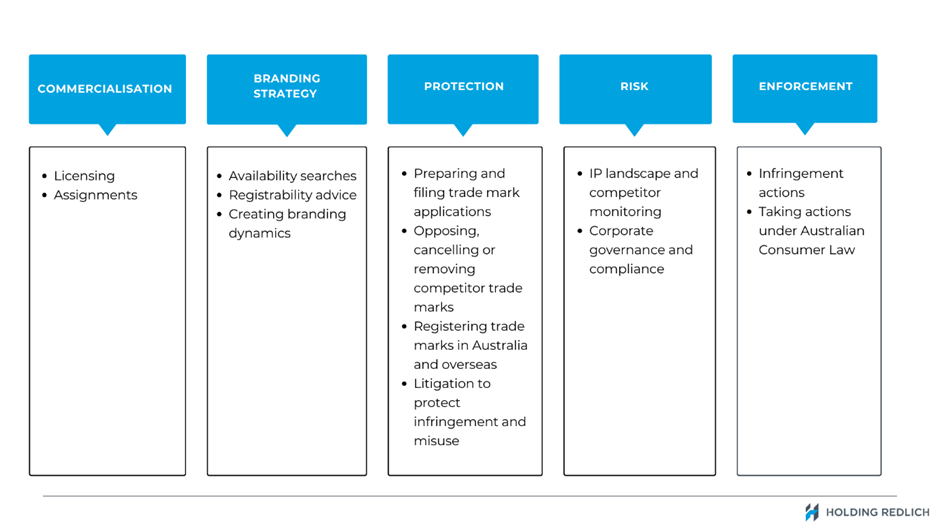
We also manage worldwide portfolios for many significant brands and we deliver protection in connection with all aspects of trade mark and brand protection services, as set out in further detail below.

If you need any assistance with auditing or reviewing your current trade marks portfolio, please contact Ian Robertson at ian.robertson@holdingredlich.com or Sarah Butler at sarah.butler@holdingredlich.com.

Disclaimer

The information in this article is of a general nature and is not intended to address the circumstances of any particular individual or entity. Although we endeavour to provide accurate and timely information, we do not guarantee that the information in this article is accurate at the date it is received or that it will continue to be accurate in the future.

Content provided by Holding Redlich Partner Ian Robertson and Special Counsel Sarah Butler

VIVE XR Elite Business virtual reality

As the Enterprise XR space and industry competition continue to grow, HTC VIVE is leading the way. At Mobile World Congress 2024, HTC VIVE is announcing new enterprise features for VIVE XR Elite Business Edition, including Location Based Software Suite support, and VIVE Business+ to make fleet management and content deployment effortless at any scale. VIVE XR Elite Business Edition also has new physical accessories to support even more versatile use cases and enhance comfort for longer sessions or multiple users.

VIVE’s hardware and software combination has seen it become the global standard for multi-user Location Based Experiences, including Arcades, Museums, Galleries, and Cultural institutions The breathtaking Horizon of Khufu started with a single venue in Lyon, France, and has seen over 150,000 visitors in just one year, resulting in expansion to nine locations across the globe.

VIVE’s hardware has also become essential in training scenarios across the world. VIVE’s hardware and software mean it’s easy to create simulations with realistic graphics, and the ability for users to move around on a 1:1 scale, even incorporating physical props.

“Every year, the XR industry is delivering more innovation to support humanity,” said Cher Wang, Chairwoman and Co-Founder of HTC. “In 2023 we helped older people to have new experiences while also optimising medical diagnostic tools. We put a VR headset onto the International Space Station for mental and physical health. And VIVE Arts helped to create a beautiful look at Vincent van Gogh’s final works, in a way never seen before. XR is inspiring people around the world, and the possibilities are endless.”

VIVE’s Location Based Software Suite also helped to develop the first functional VR system in microgravity. VIVE’s Simulator Mode was adapted for use on the International Space Station, as Commander Andreas Mogensen used a VIVE Focus 3 flawlessly for mental and physical health support. Mogensen said, “It’s actually one of my favourite activities onboard the space station… it’s a game changer.” VIVE’s LBSS is also an integral part of the upcoming large-scale multiuser exhibition at Museé d’Orsay, “Tonight with the Impressionists – Paris 1874”, celebrating 150 years of Impressionism.

The new VIVE XR Elite Business Edition features include:

  • Location Based Software Suite support
  • A new face gasket designed for high-user turnover scenarios like LBE
  • A new over-the-top headstrap, enhancing comfort and making it even easier and quicker to switch users
  • Security clips for the temple arms, to prevent anyone from removing the battery cradle

VIVE is also launching a new 5-in-1 USB-C dock for VIVE Ultimate Tracker, so that five units can be charged at the same time quickly and easily. The VIVE USB-C Dock (Five Ports) is perfect for power users and businesses who have a large number of VIVE Ultimate Trackers in use, for LBEs, group training, motion capture, and more.

VIVERSE Starter Pack

As remote collaboration becomes increasingly important across the world, VIVE is launching a special VIVERSE “Starter Pack” to help organisations build their capabilities. The VIVERSE Starter Pack promotion includes:

  • 3 months of VIVERSE for Business
  • 10x free VIVE XR Elite Business Edition units, including free VIVE Business Warranty
  • Free access to VIVE Business+ for fleet management and content deployment
  • Total savings over $12,000
  • 20x VIVE XR Elite Business Edition bundle also available, with total savings over $15,000

AI and VIVERSE

VIVERSE is also adding a number of new features, including AI tools, support for VIVE Ultimate Tracker and VIVE Full Face Tracker for VIVE XR Elite, as well as non-VR motion capture for avatars. The new AI technology includes a Personal Assistant to act as a personal tour guide, packed with information about the world the user is exploring.

The AI Personal Assistant will also function as a Voice Assistant for productivity tasks like updating the user’s personal calendar, with more features coming soon. The AI technology also supports Voice-To-Text Transcription, and Real-Time Translation into eight languages*, making it easier than ever for people from different cultures to converse.  

Helping avatars to be more realistic and expressive, VIVERSE is adding support for VIVE Ultimate Tracker for precise body tracking. VIVE Full Face Tracker is capable of eye-tracking and capturing subtle facial expressions – 38 blend shapes across the lips, jaw, cheeks, chin, teeth, and tongue at 60Hz. This means avatars will be more natural and realistic in VIVERSE. Highlighting how easy it is for organisations to add third-party solutions such as AI to their own VIVERSE avatars, HTC’s partner ACCESS will showcase avatars built using the VIVERSE Avatar SDK which incorporate AI for speech and facial expressions.